New reports from Infocom Intelligence are now available online. The table of content of the reports are available on the following web link.
http://www.infocomintelligence.com/newreports.htm
1- The technologies and strategies behind new mobile services : Profile of the Canadian industry
[Nature of mobile technologies, evolution of the industry.]
2- Formation sur l’investissement en capital privé pour les anges financiers potentiels ou actuels
The author of the reports is Louis Rhéaume, which has the scolarity of a doctorate in business administration, concentration in strategic management, innovation management and corporate finance. He holds a Master’s degree in finance and he has completed the first level of CFA. He has numerous years of experience in consulting, strategy, and financial analysis, mainly in the telecommunications and computing industries. He has also been a researcher in the group MINE (Management of Innovation in the New Economy), where he was in charge of the area of telecommunication services. Mr. Rhéaume has consulted in telecommunications, performance indicators of ITC, computing, IT security issues, video games, insurance and airlines. He is a contributor to the financial web site Seeking Alpha (http://seekingalpha.com/author/louis-rheaume). He has also published scientific articles on mergers and acquisitions, strategic management and corporate universities. His new chapter of a book on technology business models will be published soon by Nova Science. It is written with expert Dr. Yves Rabeau of UQÀM. https://www.novapublishers.com/catalog/product_info.php?products_id=25245
He is also a teacher at the Télé-Université (TELUQ-UQÀM), where he teaches 10 finance courses such as: financing, corporate finance, financial risk management, performance indicators, value creation and financial strategy, financial projects analysis. These courses belong to the University’s second cycle for the candidates to the CGA aaccounting accreditation. His thesis project was related to strategic management of innovation project portfolios and the dilemma Buy or Build innovation.
For more information you can contact us.
Louis Rhéaumne
Infocom Intelligence
louis@infocomintelligence.com
514-528-6422
Twitter: @InfocomAnalysis

A blog on the convergence of info-communications industries: communications, computing, electronics, entertainment, publications and education. Strategic, technological and financial analysis. English and French blog. Cette chronique traite de l’évolution des industries de l’information et des communications et couvre des aspects stratégiques, technologiques et financiers, comme l’économie du savoir et de l’innovation. L’auteur est Associé principal de Infocom Intelligence.
Showing posts with label mobile technologies. Show all posts
Showing posts with label mobile technologies. Show all posts
Wednesday, January 11, 2012


Nouveaux rapports de Infocom Intelligence disponible en ligne
De nouveaux rapports de Infocom Intelligence sont maintenant disponible en ligne. Les tables des matières sont sur le site web de Infocom Intelligence. (Voir lien plus bas).
http://www.infocomintelligence.com/nouveauxrapports.htm
1-The technologies and strategies behind new mobile services : Profile of the Canadian industry
[Nature of mobile technologies, evolution of the industry.]
2-Formation sur l’investissement en capital privé pour les anges financiers potentiels ou actuels
L'auteur des 2 rapports est Louis Rhéaume qui a la scolarité d'un doctorat en administration des affaires, concentration en stratégie de gestion, gestion de l'innovation et finance corporative, à l'UQÀM. Il a également une maîtrise en finance et fait le premier niveau du CFA. Il a plusieurs années d'expérience en consultation stratégique, et en analyse financière, principalement dans les industries des télécommunications et de l'informatique. Il a été aussi chercheur pour le groupe de recherche MINE (Management de l'Innovation dans la Nouvelle Économie) où il s'occupait des services de télécommunications.
M. Rhéaume a eu des mandats de consultation en télécommunications, informatique, indicateurs de performance en TIC, sécurité en TI, jeux vidéos, assurance et lignes aériennes. Il a fait quelques publications scientifiques en fusions et acquisitions, stratégie de gestion et sur les universités corporatives. Il est collaborateur au site financier Seeking Alpha (http://seekingalpha.com/author/louis-rheaume). Il est aussi chargé de cours à la Télé-Université pour 10 cours de finance au premier et deuxième cycle universitaire. Son projet de thèse de doctorat portait sur la gestion stratégique de portefeuille de projets d'innovation et le dilemme Acheter ou Concevoir l’innovation.
Pour plus de renseignements vous pouvez nous contacter.
Louis Rhéaume
Infocom Intelligence
louis@infocomintelligence.com
514-528-6422
Twitter: @InfocomAnalysis
http://www.infocomintelligence.com/nouveauxrapports.htm
1-The technologies and strategies behind new mobile services : Profile of the Canadian industry
[Nature of mobile technologies, evolution of the industry.]
2-Formation sur l’investissement en capital privé pour les anges financiers potentiels ou actuels
L'auteur des 2 rapports est Louis Rhéaume qui a la scolarité d'un doctorat en administration des affaires, concentration en stratégie de gestion, gestion de l'innovation et finance corporative, à l'UQÀM. Il a également une maîtrise en finance et fait le premier niveau du CFA. Il a plusieurs années d'expérience en consultation stratégique, et en analyse financière, principalement dans les industries des télécommunications et de l'informatique. Il a été aussi chercheur pour le groupe de recherche MINE (Management de l'Innovation dans la Nouvelle Économie) où il s'occupait des services de télécommunications.
M. Rhéaume a eu des mandats de consultation en télécommunications, informatique, indicateurs de performance en TIC, sécurité en TI, jeux vidéos, assurance et lignes aériennes. Il a fait quelques publications scientifiques en fusions et acquisitions, stratégie de gestion et sur les universités corporatives. Il est collaborateur au site financier Seeking Alpha (http://seekingalpha.com/author/louis-rheaume). Il est aussi chargé de cours à la Télé-Université pour 10 cours de finance au premier et deuxième cycle universitaire. Son projet de thèse de doctorat portait sur la gestion stratégique de portefeuille de projets d'innovation et le dilemme Acheter ou Concevoir l’innovation.
Pour plus de renseignements vous pouvez nous contacter.
Louis Rhéaume
Infocom Intelligence
louis@infocomintelligence.com
514-528-6422
Twitter: @InfocomAnalysis
Wednesday, December 21, 2011
ReadWriteWeb 2012 tech predictions
here are some of the most interesting predictions of the blog ReadWriteWeb:
Abraham Hyatt, Managing Editor
-The relative success of the New York Times' paywall (and others) will drive more experiments in getting people to pay for online content. Thanks to the Times' example, a lot newspapers and magazines will realize their print product doesn't have to be an albatross around their neck. As a result of package print/digital deals, newspaper circulation rates will slow their fall? No, that can't be right.
John Paul Titlow, Writer
-Joining Zite, one of the other popular news reading apps for the iPad will be bought by a big tech or media company. These apps still won't be profitable.
-We'll see a substantial increase in HTML5-fueled mobile Web apps as companies and publishers learn that it frees them from app store restrictions and is cheaper since it offers cross-platform support without having to code for every mobile OS individually. Still, the iTunes App Store and Android Marketplace will also continue to grow.
Dan Rowinski, Writer
-Facebook's IPO will cause an exodus of top talent from the company that creates a new class of venture capitalist and entrepreneurs in Silicon Valley in much the same way as the "Google Millionaires" did a little less than a decade ago.
Joe Brockmeier, Writer
-NFC payments, at least in North America, continue to be a niche offering. People are slow to adopt new payment options, and it will take years before NFC is widely accepted or used.
Mozilla launches its own, federated social network as an open and privacy friendly alternative to Facebook, Google+ and others.
For more information see
http://www.readwriteweb.com/archives/readwritewebs_2012_staff_predictions_and_what_we_got_wrong_in_2011.php
Louis Rhéaume
Infocom Intelligence
louis@infocomintelligence.com
Abraham Hyatt, Managing Editor
-The relative success of the New York Times' paywall (and others) will drive more experiments in getting people to pay for online content. Thanks to the Times' example, a lot newspapers and magazines will realize their print product doesn't have to be an albatross around their neck. As a result of package print/digital deals, newspaper circulation rates will slow their fall? No, that can't be right.
John Paul Titlow, Writer
-Joining Zite, one of the other popular news reading apps for the iPad will be bought by a big tech or media company. These apps still won't be profitable.
-We'll see a substantial increase in HTML5-fueled mobile Web apps as companies and publishers learn that it frees them from app store restrictions and is cheaper since it offers cross-platform support without having to code for every mobile OS individually. Still, the iTunes App Store and Android Marketplace will also continue to grow.
Dan Rowinski, Writer
-Facebook's IPO will cause an exodus of top talent from the company that creates a new class of venture capitalist and entrepreneurs in Silicon Valley in much the same way as the "Google Millionaires" did a little less than a decade ago.
Joe Brockmeier, Writer
-NFC payments, at least in North America, continue to be a niche offering. People are slow to adopt new payment options, and it will take years before NFC is widely accepted or used.
Mozilla launches its own, federated social network as an open and privacy friendly alternative to Facebook, Google+ and others.
For more information see
http://www.readwriteweb.com/archives/readwritewebs_2012_staff_predictions_and_what_we_got_wrong_in_2011.php
Louis Rhéaume
Infocom Intelligence
louis@infocomintelligence.com
Tuesday, September 13, 2011
Mobile Internet will surpass fixed Internet in 2015
According to IDC, tablets and smartphones will drive significantly the consumption of mobile Internet. It will surpass fixed Internet (PC) around 2015 in the number of users. New players such as Amazon in tablets, will push mobile Internet.
This will drive new business models to create value from mobile Internet users.
Fixed and mobile Internet users will increase from 2 billion in 2010 to around 2.7 billion in 2015.
For more analysis on the modifications of technology business models you can read, in the coming weeks the Chapter of the Book:
"Rethinking North American telephony business models in the age of turbulence."
From Louis Rhéaume, TELUQ and Yves Rabeau, UQÀM.
In the book In: Advances in Communications… Volume 8 ISBN # 978-1-61324-794-5
Editor: Anthony V. Stavros, pp. 1- 40 © 2011 Nova Science Publishers, Inc.
Available (forthcoming Q4-2011) on the website:
https://www.novapublishers.com/catalog/product_info.php?products_id=25245
Louis Rhéaume
Infocom Intelligence
louis@infocomintelligence.com
This will drive new business models to create value from mobile Internet users.
Fixed and mobile Internet users will increase from 2 billion in 2010 to around 2.7 billion in 2015.
For more analysis on the modifications of technology business models you can read, in the coming weeks the Chapter of the Book:
"Rethinking North American telephony business models in the age of turbulence."
From Louis Rhéaume, TELUQ and Yves Rabeau, UQÀM.
In the book In: Advances in Communications… Volume 8 ISBN # 978-1-61324-794-5
Editor: Anthony V. Stavros, pp. 1- 40 © 2011 Nova Science Publishers, Inc.
Available (forthcoming Q4-2011) on the website:
https://www.novapublishers.com/catalog/product_info.php?products_id=25245
Louis Rhéaume
Infocom Intelligence
louis@infocomintelligence.com
Friday, March 25, 2011
Article on telecom operator Telenor published on Seeking Alpha
Our article on telecom operator Telenor was published on Seeking Alpha.
http://seekingalpha.com/article/260202-telenor-asa-still-has-attractive-valuation
http://seekingalpha.com/article/260202-telenor-asa-still-has-attractive-valuation
Wednesday, November 17, 2010
What is the potential of Research in Motion (RIM.TO)?
In mobile platforms all the hype actually is on Apple and Android (Google). Their market shares are rising quickly in the US. For the CEO of Apple Steve Jobs, ““We’ve now past RIM, and I don’t see them catching up to us in the near future.”
Balsillie co-CEO of RIM answered: ” The implication being that RIM practically invented the smartphone category and is not going anywhere.”
RIM has a different attitude toward web apps than Apple. There may be 300,000 apps for the iPhone and iPad, but according to RIM CEO, the only app you really need is the browser. “You don’t need an app for the Web,” he says, and that is equally true for the mobile Web. Blackberry is betting heavily on the Web, similarly to Google.
Positive aspects:
-New RIM mobile ad network : good potential.
-New potential of Playbook blackberry tablet; cheaper than the iPad, but 3 to 4 times faster than the iPad. It will be launch at the beginning of 2011 and support Flash applications.
-Potential in new emerging markets: RIM smartphones are better value with BB messenger : free real-time SMS and lower cost of smartphone. In Latin America and several part of the globe, the majority of users are prepaid users who can’t benefit from subsidies on the smartphone or from long-term contract.


Negative aspects:
-RIM position on development of apps. For co-CEO Balsillie, people prefers mobile web to native apps. When the difference is un-significant it is true, but unfortunately it is not always the case. One big example: www.youtube.com on mobile doesn’t play all your videos. The free app plays videos of the day but you can’t search that you want in the library. The $2.99 native app let you play the videos of your choice.
-RIM is losing market share mainly in the US over Apple and Android.
Outlook
Even with global market share shrinking slightly the stock is cheap, so the short term potential is good. Will RIM be a major brand and mobile platform in 10 years? I’m not so sure in the US for the consumers sector but it will remain an important player in the business sector. However, the company has competitive advantages in the emerging markets. It offers a good ratio quality/price for these customers.
With a P/E ratio of 11.1, the stock seems cheap. The global smartphone market is growing quickly.
Apple P/E ratio is 19.91, less if you consider the $51 billion in cash and has the momentum, but the question is can it maintain its higher valuation in the medium and long term? I remember my economist teacher who said 14 years ago that in the tech sector, you can’t hold many tech stocks for the long term. You have to trade more often. 2 stock crashs later he had a good point.
Apple's mobile ecosystems growth are remarkable (you can see the second graph), but the valuation of the firm is actually taken that into account. RIM valuation is not taking completely into account all of these growth factors.
Louis Rhéaume
Infocom Intelligence
Monday, November 15, 2010
What is hot in mobile games?
It appears that 61% of US smartphones users in October have used at least one mobile game. Mergers and acquisitions in mobile games are hot. In October, Ngmoco was sold to DeNA for $400M, providing a 1000% return for private shareholders. On the other hand, Chillingo was acquired only for $20M by Electronic Arts. Zynga an online game provider is now valued on the secondary market at $5.27 billion on SharesPost. According to Levi Shapiro, Partner, TMT Strategic Advisors, these 10 mobile games companies are very interesting acquisitions targets. It can be very useful to know why they are attractive for video game developers, such as those in the Montreal Video game cluster.
1-Rovio: The Finnish developer of “Angry Birds” is the No. 1 game in 70 countries with more than 30 million downloads, including 10 million paid downloads. Their strategy includes affordable pricing (99 cents) and ongoing engagement (free updates every 4 weeks). Using AdMob’s in-app advertising tools and their own house ads, Rovio is estimated to be earning $500,000 to $700,000 in monthly paid app and ad-supported revenue. Clearly, this is a company that could scale into a much larger player and has set the lofty goal of 100 million downloads, something only Tetris (Electronic Arts) has achieved. Potential buyers will need to bring scale and reach to migrate an iOS and Android success story into a “Transmedia Property.” Just as Disney bought iPhone game developer Tapulous earlier this year for a reported $50 million (including earn-out), studios like Sony, Paramount, 20th Century Fox and Warner Brothers could soon bring “Angry Birds” to a cinema, bookstore, console game or toothbrush near you.
2-Unity 3D: 3D has moved beyond the cinema to the TV, laptop, handset and game console. For example, Nintendo announced its glasses-free, 3DS portable game player. Moreover, handset vendors are desperate to distinguish their wares and several original equipment manufacturers – including Sharp Corp., Motorola Inc., LG Electronics Co. Ltd. and Toshiba Corp. – are working on 3D handsets. What is missing is content – game developers don’t see a large audience ready to purchase 3D games. This year, global 3D TV sales are unlikely to surpass 5 million units. However, by 2015 that number should scale to between 50 million and 88 million new 3D TV’s. Unity 3D provides a platform for developers to quickly create and deploy 3D games for online, television, console and mobile. Unity has more than 200,000 registered developers worldwide, including Electronic Arts, Disney and Coca Cola. This could be an interesting strategic acquisition for a variety of players seeking competitive advantage in the 3D gaming sector.
3-Greystripe: Want to start a “show me the money” discussion on Madison Avenue? Try raising the subject of mobile advertising. The entire sector is projected to reach less than $750 million this year (eMarketer), a pittance compared to the $70 billion on television advertising. However, a growing number of Q4 campaigns from retail, automotive and consumer packaged goods brands suggests rapid growth. This is what inspired Apple’s $250 million acquisition this year of Quattro Wireless and Google’s $750 million purchase of AdMob. Among the remaining independents, Greystripe is strong in the in-app advertising sector. Although games downloaded via app stores will contribute only 30% of U.K. mobile game revenues this year, the success of the Apple App Store has inspired new entrants to the app store fray, from Samsung Electronics Co. Ltd. to Amazon.com Inc. Look for Greystripe to get swallowed as the big guys prepare for war.
4-Gypsii: Think of Gypsii as a combination of Twitter and Foursquare for China. Micro-blogging (weibao) is a booming, although not yet profitable, sector in China. Local Twitter clone Sina Weibo claims to be the largest micro-blogging service in China, with more than 20 million registered users since launching in August 2009. Gypsii uses a hybrid subscription and ad revenue sharing model, including location-aware couponing, to incentivize its wireless carrier partners. In less than two years, Gypsii has deals with all three Chines carriers, nearly 3 million users and pre-load agreements with Nokia Corp., LG, Samsung, Lenovo and Huawei Technologies Ltd. Despite the slow 3G uptake in China, there are nearly 400 million active mobile Internet users in the Middle Kingdom. This includes the 50 million Chinese consumers earning $20,000 annually and spending at least $22 per month on mobile services. Web, mobile and e-commerce (still only $2.5 billion out of last year's $29 billion online eCommerce sector) companies seeking carrier relationships and a large base of consumers will be very interested in Gypsii.
5-Aurora Feint: While Apple may have its own social gaming network (GameCenter), third party social gaming networks like Ngmoco’s Plus+ and German business to business social gaming platform Scoreloop have built large user bases. Aurora Feint takes a multi-platform approach, with expertise in iOS (iPhone, iTouch, iPad) and Android and cloud-based game services like leaderboards, achievements and virtual currencies. Aurora Feint’s high traffic numbers in the United States – 3,400 games and over 45 million mobile gamers – make it the volume play in this sector and helped attract investment from major Chinese and Japanese gaming companies as well as Intel Capital. The company is poised to expand its user base with a deal announced last quarter with Verizon Wireless to curate and provide Android game recommendations.
6-Vivox: Until the advent of video games, humans generally played games with other people. Vivox, and quite a few other players, recognized the importance of social interaction and created a platform for developers and social networks to integrate voice chat, video, instant messaging and presence within the visual experience. The advantage for Vivox is the installed base of 25 million users across 180 countries and 2 billion minutes of monthly voice chat. Even if voice is rapidly becoming a commodity, Vivox’s scale could compliment the expansion goals for large game publishers, virtual worlds or social networks.
7-Backflip Studios: Few studios consistently crank out hit games. Boulder, Colorado-based Backflip Studios has now had nearly 50 million downloads and a daily active user base of two million. In fact, its first four iPhone releases, including Paper Toss, Graffiti Ball, Strike Knight and NinJump, were all downloaded over four million times and ranked in the top five in Apple’s overall app store lists. Most importantly, Backflip is generating solid revenue through in-app advertising (iAd and AdMob) and cross promoting its paid games via its free games. Considering that research firm Flurry estimates the average revenue generated per online active daily user is $1.22, Backflip brings an interesting revenue base as well as its track record of making popular games.
8-Free App A Day: Free App A Day is a website, app and community platform for the promotion of paid games on iPhone and Android that are free for a limited period. Apple’s App Store is now loaded with more than 240,000 apps, making discovery one of the biggest challenges facing publishers. The company has over a million active daily users and is now a King Maker for pushing games and apps into the top 10. Developers and publishers give away their apps for free for a limited time. Once these revert to paid status, the promotional effects from the daily push notifications offset the lost publisher revenue. Free App A Day then keeps a share of publisher paid app revenue for a fixed period.
9-Smule: No one is cranking out hit iPhone music applications like Smule. Having raised $13.5 million and achieved success with iPhone apps like “I am T-Pain,” “Ocarina,” “Glee Karaoke” and “Leaf Trombone,” the developers are now creating iPad versions. Given that 91% of iPad owners have downloaded an application and two thirds paid for these, it is no surprise that Smule already has its first iPad success story in “Magic Piano.” According to Smule, users played one of the songs, “Twinkle Twinkle Little Star,” more than 750,000 times. In fact, world-renowned pianist Lang Lang performed “Flight of the Bumblebee” on Magic Piano at the San Francisco Orchestra. This kind of engagement has many wondering if Smule will be the next Slide, which was acquired by Google in August for $182 million.
10-Flurry: Although virtual goods are the dominant form of monetization for online social games, until mobile application research firm Flurry released a report earlier this month, few knew that same trend has already come to mobile. Measuring its network of more than 50,000 developers across iPhone and Android, Flurry identified 80% of in-app revenue from micro-transactions, with the rest coming from ads. Despite a highly publicized spat with Steve Jobs earlier this year, as an analytics provider Flurry could be attractive to the likes of Nielsen, Comscore and NPD. Hedging its bets, Flurry has created its own set of tools for helping the developer community integrate virtual currency into their activities.
Source:
http://www.rcrwireless.com/article/20101110/OPINION/101109940
Louis Rhéaume
Infocom Intelligence
louis@infocomintelligence.com
1-Rovio: The Finnish developer of “Angry Birds” is the No. 1 game in 70 countries with more than 30 million downloads, including 10 million paid downloads. Their strategy includes affordable pricing (99 cents) and ongoing engagement (free updates every 4 weeks). Using AdMob’s in-app advertising tools and their own house ads, Rovio is estimated to be earning $500,000 to $700,000 in monthly paid app and ad-supported revenue. Clearly, this is a company that could scale into a much larger player and has set the lofty goal of 100 million downloads, something only Tetris (Electronic Arts) has achieved. Potential buyers will need to bring scale and reach to migrate an iOS and Android success story into a “Transmedia Property.” Just as Disney bought iPhone game developer Tapulous earlier this year for a reported $50 million (including earn-out), studios like Sony, Paramount, 20th Century Fox and Warner Brothers could soon bring “Angry Birds” to a cinema, bookstore, console game or toothbrush near you.
2-Unity 3D: 3D has moved beyond the cinema to the TV, laptop, handset and game console. For example, Nintendo announced its glasses-free, 3DS portable game player. Moreover, handset vendors are desperate to distinguish their wares and several original equipment manufacturers – including Sharp Corp., Motorola Inc., LG Electronics Co. Ltd. and Toshiba Corp. – are working on 3D handsets. What is missing is content – game developers don’t see a large audience ready to purchase 3D games. This year, global 3D TV sales are unlikely to surpass 5 million units. However, by 2015 that number should scale to between 50 million and 88 million new 3D TV’s. Unity 3D provides a platform for developers to quickly create and deploy 3D games for online, television, console and mobile. Unity has more than 200,000 registered developers worldwide, including Electronic Arts, Disney and Coca Cola. This could be an interesting strategic acquisition for a variety of players seeking competitive advantage in the 3D gaming sector.
3-Greystripe: Want to start a “show me the money” discussion on Madison Avenue? Try raising the subject of mobile advertising. The entire sector is projected to reach less than $750 million this year (eMarketer), a pittance compared to the $70 billion on television advertising. However, a growing number of Q4 campaigns from retail, automotive and consumer packaged goods brands suggests rapid growth. This is what inspired Apple’s $250 million acquisition this year of Quattro Wireless and Google’s $750 million purchase of AdMob. Among the remaining independents, Greystripe is strong in the in-app advertising sector. Although games downloaded via app stores will contribute only 30% of U.K. mobile game revenues this year, the success of the Apple App Store has inspired new entrants to the app store fray, from Samsung Electronics Co. Ltd. to Amazon.com Inc. Look for Greystripe to get swallowed as the big guys prepare for war.
4-Gypsii: Think of Gypsii as a combination of Twitter and Foursquare for China. Micro-blogging (weibao) is a booming, although not yet profitable, sector in China. Local Twitter clone Sina Weibo claims to be the largest micro-blogging service in China, with more than 20 million registered users since launching in August 2009. Gypsii uses a hybrid subscription and ad revenue sharing model, including location-aware couponing, to incentivize its wireless carrier partners. In less than two years, Gypsii has deals with all three Chines carriers, nearly 3 million users and pre-load agreements with Nokia Corp., LG, Samsung, Lenovo and Huawei Technologies Ltd. Despite the slow 3G uptake in China, there are nearly 400 million active mobile Internet users in the Middle Kingdom. This includes the 50 million Chinese consumers earning $20,000 annually and spending at least $22 per month on mobile services. Web, mobile and e-commerce (still only $2.5 billion out of last year's $29 billion online eCommerce sector) companies seeking carrier relationships and a large base of consumers will be very interested in Gypsii.
5-Aurora Feint: While Apple may have its own social gaming network (GameCenter), third party social gaming networks like Ngmoco’s Plus+ and German business to business social gaming platform Scoreloop have built large user bases. Aurora Feint takes a multi-platform approach, with expertise in iOS (iPhone, iTouch, iPad) and Android and cloud-based game services like leaderboards, achievements and virtual currencies. Aurora Feint’s high traffic numbers in the United States – 3,400 games and over 45 million mobile gamers – make it the volume play in this sector and helped attract investment from major Chinese and Japanese gaming companies as well as Intel Capital. The company is poised to expand its user base with a deal announced last quarter with Verizon Wireless to curate and provide Android game recommendations.
6-Vivox: Until the advent of video games, humans generally played games with other people. Vivox, and quite a few other players, recognized the importance of social interaction and created a platform for developers and social networks to integrate voice chat, video, instant messaging and presence within the visual experience. The advantage for Vivox is the installed base of 25 million users across 180 countries and 2 billion minutes of monthly voice chat. Even if voice is rapidly becoming a commodity, Vivox’s scale could compliment the expansion goals for large game publishers, virtual worlds or social networks.
7-Backflip Studios: Few studios consistently crank out hit games. Boulder, Colorado-based Backflip Studios has now had nearly 50 million downloads and a daily active user base of two million. In fact, its first four iPhone releases, including Paper Toss, Graffiti Ball, Strike Knight and NinJump, were all downloaded over four million times and ranked in the top five in Apple’s overall app store lists. Most importantly, Backflip is generating solid revenue through in-app advertising (iAd and AdMob) and cross promoting its paid games via its free games. Considering that research firm Flurry estimates the average revenue generated per online active daily user is $1.22, Backflip brings an interesting revenue base as well as its track record of making popular games.
8-Free App A Day: Free App A Day is a website, app and community platform for the promotion of paid games on iPhone and Android that are free for a limited period. Apple’s App Store is now loaded with more than 240,000 apps, making discovery one of the biggest challenges facing publishers. The company has over a million active daily users and is now a King Maker for pushing games and apps into the top 10. Developers and publishers give away their apps for free for a limited time. Once these revert to paid status, the promotional effects from the daily push notifications offset the lost publisher revenue. Free App A Day then keeps a share of publisher paid app revenue for a fixed period.
9-Smule: No one is cranking out hit iPhone music applications like Smule. Having raised $13.5 million and achieved success with iPhone apps like “I am T-Pain,” “Ocarina,” “Glee Karaoke” and “Leaf Trombone,” the developers are now creating iPad versions. Given that 91% of iPad owners have downloaded an application and two thirds paid for these, it is no surprise that Smule already has its first iPad success story in “Magic Piano.” According to Smule, users played one of the songs, “Twinkle Twinkle Little Star,” more than 750,000 times. In fact, world-renowned pianist Lang Lang performed “Flight of the Bumblebee” on Magic Piano at the San Francisco Orchestra. This kind of engagement has many wondering if Smule will be the next Slide, which was acquired by Google in August for $182 million.
10-Flurry: Although virtual goods are the dominant form of monetization for online social games, until mobile application research firm Flurry released a report earlier this month, few knew that same trend has already come to mobile. Measuring its network of more than 50,000 developers across iPhone and Android, Flurry identified 80% of in-app revenue from micro-transactions, with the rest coming from ads. Despite a highly publicized spat with Steve Jobs earlier this year, as an analytics provider Flurry could be attractive to the likes of Nielsen, Comscore and NPD. Hedging its bets, Flurry has created its own set of tools for helping the developer community integrate virtual currency into their activities.
Source:
http://www.rcrwireless.com/article/20101110/OPINION/101109940
Louis Rhéaume
Infocom Intelligence
louis@infocomintelligence.com
Tuesday, October 19, 2010
The day that mobile data will surpass mobile voice is coming
We saw in an earlier post that mobile data revenue will take over fixed voice revenue around 2011.
ttp://infocomanalysis.blogspot.com/search/label/fix%20telephony
It appears that mobile voice has already been surpassed by mobile data traffic on some networks, and it is definitely accelerating. The main reason is that Mobile data usage continues to grow exponentially as 3G technology expands globally. ABI Research predicts that from 2009 to 2015 data usage in Western Europe and North America is expected to increase at a compound annual growth rate (CAGR) of 42% and 55% respectively.
While mobile data revenues are expected to grow at a CAGR of about 18% in North America, this is in sharp contrast to the increase in usage. In 2010, the average North American user is expected to consume 159 megabytes of data – up from 100 megabytes in 2009.
The growth in data traffic is cannibalizing (at the cost of) voice revenues. Thus, minutes of use are on the decline in developed markets in North America and Western Europe.
Louis Rhéaume
Infocom Intelligence
louis@infocomintelligence.com
ttp://infocomanalysis.blogspot.com/search/label/fix%20telephony
It appears that mobile voice has already been surpassed by mobile data traffic on some networks, and it is definitely accelerating. The main reason is that Mobile data usage continues to grow exponentially as 3G technology expands globally. ABI Research predicts that from 2009 to 2015 data usage in Western Europe and North America is expected to increase at a compound annual growth rate (CAGR) of 42% and 55% respectively.
While mobile data revenues are expected to grow at a CAGR of about 18% in North America, this is in sharp contrast to the increase in usage. In 2010, the average North American user is expected to consume 159 megabytes of data – up from 100 megabytes in 2009.
The growth in data traffic is cannibalizing (at the cost of) voice revenues. Thus, minutes of use are on the decline in developed markets in North America and Western Europe.
Louis Rhéaume
Infocom Intelligence
louis@infocomintelligence.com
Tuesday, October 12, 2010
Who is still the leader in smartphones?


Blackberry is still the most popular operating system (OS) platform for smartphones around the world with a presence in around 70% of firms in North America and Europe in Q1 2010. However, among consumers and business smartphones users, RIM is also the leader but is challenged by the growth of Android of Google. Even though Apple experienced fast growth with its iPhone, they lost a bit of market share between May and August this year. Finally, Microsoft just announced the launch of Windows phone 7 which resemble Android http://news.yahoo.com/s/ap/20101011/ap_on_hi_te/us_tec_microsoft_phones
Louis Rhéaume
Infocom Intelligence
louis@infocomintelligence.com
Tuesday, May 11, 2010
Intelligent use of mobile technology can help you find balance

There was an interesting article in the Financial Post yesterday, about the balance between work and personal life with mobile technologies. I can tell you the story of a ex-boss who was sleeping with his Blackberry; or a Chief Strategist at BCE who answered my email 30 minutes later, at 8 PM. Several people face the pressure of always been available and always keep their cellphone "on".
Sunday, March 14, 2010
La rentabilité de la dépendance technologique

Gartner prévoit qu'il se vendra d'ici 2ans plus de téléphones intelligents que de PC à travers le monde. Ceci veut dire qu'il y aura plus de nouveaux utilisateurs d'internet mobile que fixe dans le monde. Les nouvelles technologies créent souvent chez plusieurs personnes une sorte de dépendance. On n'a qu'à penser aux années de gloire de la radio dans les années 40 et 50, du téléphone fixe depuis des décennies, de la télévision dans les années 60 et 70. Une nouvelle technologie créent un engouement dans la société qui vient à son tour créer une certaine dépendance chez certaines personnes.
Avant l'arrivée d'Internet les gens regardaient environ une vingtaine d'heures de télévision par semaine au Canada. Cela a diminué quelque peu malgré l'arrivée de centaines de nouveaux canaux sur le câble et le satellite. Les gens de moins de 40 ans ont tendance à consommer maintenant beaucoup d'Internet fixe et aussi mobile. Beaucoup de gens sont accros au Blackberry ou au iPhone. Les nouveaux opérateurs de sans fil au Canada pourront miser sur cet effet pour offrir des plans plus avantageux de données pour le service internet mobile. Les opérateurs canadiens actuels ne l'ont pas vraiment compris: il faut partager les revenus avec les fournisseurs d'applications et offrir l'internet mobile à des tarifs avantageux pour créer une dépendance très rentable. Au Japon, NTT DoCoMo l'a compris depuis presque 10 ans déjà.
Avec des forfaits plus avantageux voix et données, les gens sont de plus en plus dépendants de leur cellulaire et de façon plus intense avec leur cellulaire intelligent, ou nouvel appareil mobile comme le iPad. Ceux-ci deviennent un prolongement de leur esprit et contient plein de renseignements de leur vie sociale. Ajoutons à cela de nouvelles applications web comme facebook, blogue ou Twitter et les gens vont sentir un besoin quotidien d'utiliser l'internet mobile.
Le succès de l'iPhone de Apple réside entre autre sur le fait que la compagnie partage 70% des revenus d'une application avec son fournisseur. Chez NTT DocoMo c'est environ 90%.
La création de la valeur dans l'ère post-crash techno de 2000-2001, réside beaucoup dans la capacité du fournisseur de produits ou services technologiques de créer une grande ou petite dépendance chez l'utilisateur. On n'a qu'à penser à Google, Apple, Facebook et RIM.
“Mobile Web adoption is growing eight times faster than the first wave of PC Internet adoption” affirme le président de Google Eric Schmidt.
Louis Rhéaume
Infocom Intelligence
louis75@sympatico.ca
Friday, June 06, 2008
New report on Canadian mobile technologies and strategies
Our new report on Canadian mobile technologies and strategies is available for $245.
The technologies and strategies behind new mobile services
Profile of the Canadian industry
[Nature of mobile technologies, evolution of the industry.]
By: Louis Rhéaume, Senior Partner, Infocom Intelligence
2007
75 pages
The technologies and strategies behind new mobile services:
Profile of the Canadian industry
TABLE OF CONTENT Page
1.0 Mobile technologies................................................................................................................. 4
1.1 The info-communications industry............................................................................ 4
2.1.2 Major issues
2.1.3 Innovation dynamics
1.2 Nature of mobile technologies.................................................................................. 10
1.2.0 Networks.................................................................................................................... 10
2.2.1 Key Canadian carriers and their networks
2.2.2 Wi-Fi
2.2.3 Inukshuk: wireless broadband network
2.2.4 WiMAX = 4G?
1.3.0 Receivers and transmitters.................................................................................... 17
2.3.1 Mobile transmitters, RFID
2.3.2 Mobile receivers, mobile phones and PDAs
1.4.0 Mobile Voice............................................................................................................ 19
1.5.0 Protocols................................................................................................................. 21
2.5.1. Messaging
2.5.2. Bluetooth
1.6.0 Other promising new mobile technologies................................................. 24
1.6.1 The impact of Skype
1.6.2 Apple upcoming iPhone
1.6.3 Convergence is influencing mobile technologies
1.6.4 Fixed-mobile convergence (FMC)
1.6.5 Mobile payments solutions
1.6.6 New mobile data services
Case Study I: Oz Communications.......................................................................31
Case Study II: Wavesat.........................................................................................35
Case Study III: Flick software ..........................................................................................39
Case Study IV: Corus Entertainment................................................................................41
Case Study V: Ericsson Canada ...................................................................................... 44
Case Study VI: Nurun.........................................................................................................46
Appendix I: List of acronyms....................................................................................................... 49
Appendix II: Innovations in semi-conductor and radio technology........................................ 59
Appendix III: Value mapping of wireless data access technologies........................................60
Appendix IV: Canadian wireless operators’ network for innovation........................................61
Appendix V: The changing role of the mobile network operator............................................. 62
Appendix VI: Adoption timeframe of future m-commerce services........................................ 63
Appendix VII: Key activities for mobile innovation management............................................64
Appendix VIII: Framework criteria to evaluate a new mobile innovation project....................65.
Appendix IX: Examples of customer driven innovations from a mobile society.....................66
Appendix X: Customers top priorities when choosing a mobile phone....................................67
Appendix XI: New applications in Europe and Asia................................................................... 68
Appendix XII: Evolutionary paths for co-evolving consumer demand.......................................69
Appendix XIII: The infocommunications industry : a layer model........................................... 70
Appendix XIV: Competing networks and technologies in the local access market.................71
Appendix XV: The old information Mega-Industry........................................ ..............................72
Appendix XVI: How the Information industry is realigning........................................ ................73
Appendix XVII: Telecom operators’ portfolios........................................ .....................................74
Appendix XVIII: The process of information networking........................................ ....................75
To receive a PDF or paper document, contact us at louis75@sympatico.ca
Louis Rhéaume
Infocom Intelligence
http://www.infocomintelligence.com/
The technologies and strategies behind new mobile services
Profile of the Canadian industry
[Nature of mobile technologies, evolution of the industry.]
By: Louis Rhéaume, Senior Partner, Infocom Intelligence
2007
75 pages
The technologies and strategies behind new mobile services:
Profile of the Canadian industry
TABLE OF CONTENT Page
1.0 Mobile technologies................................................................................................................. 4
1.1 The info-communications industry............................................................................ 4
2.1.2 Major issues
2.1.3 Innovation dynamics
1.2 Nature of mobile technologies.................................................................................. 10
1.2.0 Networks.................................................................................................................... 10
2.2.1 Key Canadian carriers and their networks
2.2.2 Wi-Fi
2.2.3 Inukshuk: wireless broadband network
2.2.4 WiMAX = 4G?
1.3.0 Receivers and transmitters.................................................................................... 17
2.3.1 Mobile transmitters, RFID
2.3.2 Mobile receivers, mobile phones and PDAs
1.4.0 Mobile Voice............................................................................................................ 19
1.5.0 Protocols................................................................................................................. 21
2.5.1. Messaging
2.5.2. Bluetooth
1.6.0 Other promising new mobile technologies................................................. 24
1.6.1 The impact of Skype
1.6.2 Apple upcoming iPhone
1.6.3 Convergence is influencing mobile technologies
1.6.4 Fixed-mobile convergence (FMC)
1.6.5 Mobile payments solutions
1.6.6 New mobile data services
Case Study I: Oz Communications.......................................................................31
Case Study II: Wavesat.........................................................................................35
Case Study III: Flick software ..........................................................................................39
Case Study IV: Corus Entertainment................................................................................41
Case Study V: Ericsson Canada ...................................................................................... 44
Case Study VI: Nurun.........................................................................................................46
Appendix I: List of acronyms....................................................................................................... 49
Appendix II: Innovations in semi-conductor and radio technology........................................ 59
Appendix III: Value mapping of wireless data access technologies........................................60
Appendix IV: Canadian wireless operators’ network for innovation........................................61
Appendix V: The changing role of the mobile network operator............................................. 62
Appendix VI: Adoption timeframe of future m-commerce services........................................ 63
Appendix VII: Key activities for mobile innovation management............................................64
Appendix VIII: Framework criteria to evaluate a new mobile innovation project....................65.
Appendix IX: Examples of customer driven innovations from a mobile society.....................66
Appendix X: Customers top priorities when choosing a mobile phone....................................67
Appendix XI: New applications in Europe and Asia................................................................... 68
Appendix XII: Evolutionary paths for co-evolving consumer demand.......................................69
Appendix XIII: The infocommunications industry : a layer model........................................... 70
Appendix XIV: Competing networks and technologies in the local access market.................71
Appendix XV: The old information Mega-Industry........................................ ..............................72
Appendix XVI: How the Information industry is realigning........................................ ................73
Appendix XVII: Telecom operators’ portfolios........................................ .....................................74
Appendix XVIII: The process of information networking........................................ ....................75
To receive a PDF or paper document, contact us at louis75@sympatico.ca
Louis Rhéaume
Infocom Intelligence
http://www.infocomintelligence.com/
Monday, December 18, 2006
Fixed-mobile convergence phones are coming soon to North America

British Telecom (BT) has launched FMC (Fixed-mobile Convergence) phones tailored for SMEs. It means that GSM mobile phones can be used in UK at the price of a wireline phone at home because of WiFi capability. Eventually they will be available at other Wifi hotspots in Britain and around the world in GSM countries like Canada (Rogers's network). These phones will enable cheap phone calls and wireless Internet access in places such as homes with WiFi networks/routers, business locations, airports, railway stations, hotels, bars, restaurants, and foreign countries WiFi hotpots.
Also available free is Call Minder Multi, BT’s smart messaging service, which combines the customer’s mobile and landline voicemail, giving them only one mailbox to call to pick up all their messages.
These popular Wifi FMC phones will be probably available in Canada by 2007-2008 and across the world.
http://www.btplc.com/News/Articles/Showarticle.cfm?ArticleID=81e3a4df-56bc-4005-b964-1389d8612c23
Louis Rhéaume
Infocom Intelligence
infocom@videotron.ca
514-528-6422
Wednesday, November 01, 2006
Quelques conclusions intéressantes du rapport Industry Surveys: Telecommunications Wireless September 2006
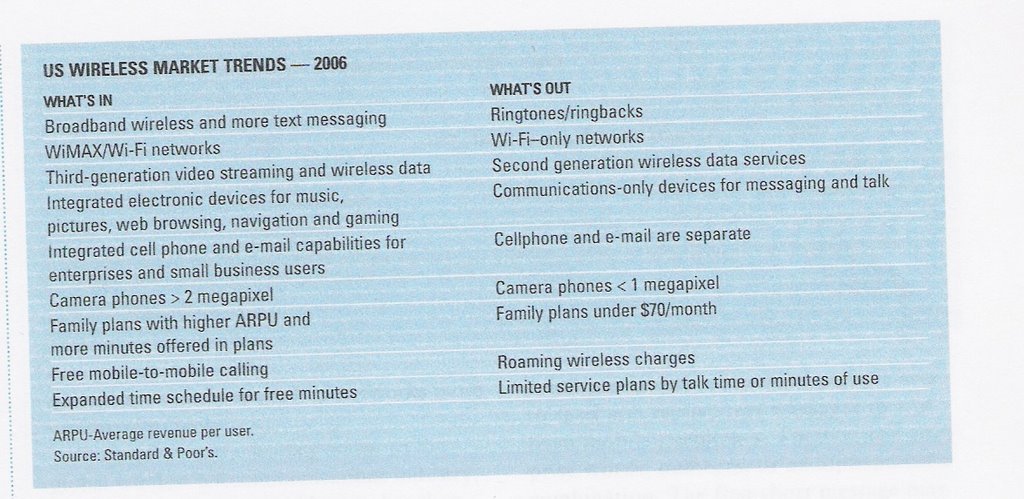
Voici 5 conclusions intéressantes du rapport Industry Surveys: US Telecommunications Wireless September 2006 de Standard & Poor's.
1- Le sans fil commence à remplacer sérieusement le filaire
Chez les Américains de 18-24 ans, 38% utilisent seulement le sans-fil. D'ici le début de 2007, 14% des abonnés seront exclusivement sans-fil.
2-Le SMS (messagerie texte) prend du momentum
33% des 25-34 ans utilisent le SMS régulièrement, 62% des 18-24 ans. 37% des abonnés américains en ont envoyés versus 69% en France, 80% en Allemagne et 85% en Grande-Bretagne. En Europe et en Asie le SMS coûte souvent moins cher qu'un appel par cellulaire.
3-Le Wi-Fi devient une menace sérieuse aux opérateurs sans-fil
Des compagnies comme Earthlink vont offrir des téléphones Wi-Fi avec des tarifs allant jusqu'à 20% du coût des compétiteurs.
4-Les MVNO (opérateurs sans fil sans infrastructure) ont des croissances très inégales
Les 3 premiers MVNO aux USA (Virgin, TracFone et Boost Mobile) s'accaparent 65% du marché MVNO. Les autres comme ESPN et Disney ont plus de difficulté. ESPN Mobile va même fermer ses portes.
5- Les tendances in & out
On y retrouve entre autre l'élément multifonctionnel du cellulaire comme élément in
Voir tableau en haut.
Louis Rhéaume
Infocom Intelligence
infocom@videotron.ca
http://www.infocomintelligence.com/
Sunday, October 22, 2006
Blackberry Pearl versus Treo 700p: which one is the best?

There is a debate among technology consumers whether the Blackberry Pearl is better than the Treo 700p. Each phone has its own set of features, but it appears that the Blackberry Pear is particularly good with both PDA and cellphone features that work.
You can see a video of 2 reporters that compare each one at:
http://revision3.com/indigital/2006-09-26
The Internet browser of the Treo appears to have some problems.
Louis Rhéaume
Infocom Intelligence
infocom@videotron.ca
www.infocomintelligence.com
Monday, September 25, 2006
L'essor du micro-paiement sur cellulaire
Dans un ancien commentaire, je soulevais l'idée que les Européens (et un peu plus tard les Nord-américains) pourraient vraiment s'intéresser à payer pour recevoir du contenu sur leur cellulaire. Un article d'un magazine suggérait alors que la vaste majorité des gens ne veulent pas payer pour ce contenu. Or, mon principal argument était qu'une offre bien ciblée avec le bon modèle d'affaires permettraient aux opérateurs sans-fil de vendre du contenu pertinent (services, divertissement, information).
Et bien, de nouvelles technologies émergent et sont en voie d'être adoptées par de plus en plus d'opérateurs. Les compagnies qui adoptent des services d'abonnement de micro-paiement commencent à obtenir beaucoup de succès. Des solutions de micro-paiement comme Payforit et I-Mode sont en train de se substituer à la monnaie, la carte de débit et la carte de crédit en Europe.
Pour en savoir plus entre autre sur les innovations en divertissement mobile il y a le très bon blogue http://mobileentertainment.libsyn.com/ . Il offre aussi des podcast sur le sujet.
Louis Rhéaume
Infocom Intelligence
www.infocomintelligence.com
infocom@videotron.ca
Et bien, de nouvelles technologies émergent et sont en voie d'être adoptées par de plus en plus d'opérateurs. Les compagnies qui adoptent des services d'abonnement de micro-paiement commencent à obtenir beaucoup de succès. Des solutions de micro-paiement comme Payforit et I-Mode sont en train de se substituer à la monnaie, la carte de débit et la carte de crédit en Europe.
Pour en savoir plus entre autre sur les innovations en divertissement mobile il y a le très bon blogue http://mobileentertainment.libsyn.com/ . Il offre aussi des podcast sur le sujet.
Louis Rhéaume
Infocom Intelligence
www.infocomintelligence.com
infocom@videotron.ca
Sunday, July 30, 2006
L'adoption des nouveaux services mobile
Le magazine Direction informatique rapportait dans son édition électronique du 26 juillet 2006 que: "Les Japonais s'intéressent à l'utilisation de leur cellulaire pour payer des produits, les Européens, eux , ne veulent pas payer pour des services évolués".
L'introduction est assez trompeuse. Oui, il est vrai que les Japonais ont 3-4 ans d'avance sur l'utilisation du cellulaire comme carte de débit, comparativement aux Européens et Américains.
Le système i-mode de NTT DoCoMo a fait en sorte de favoriser la création de nouveaux services mobiles dans une optique de partage des revenus et profits avec les fournisseurs de contenu. Avec une offre de service variée, et une contribution modeste d'une transaction aux profits de DoCoMo, la compagnie a misé sur le volume de transaction pour favoriser la popularité du service et de "l'écosystème" des services mobiles au Japon.
Ainsi, 43% des Japonais utilisent une carte ou leur téléphone cellualire pour faire leur achat. Le cellulaire est particulièrement utile pour payer les très faibles transactions: machine distributrice, café, stationnement, transport en commun, etc.
D'autre part, l'article semble affirmer que les Européens ne s'intéressent pas aux services évolués mobile comme le portefeuille mobile (mobile wallet) ou la télé sur cellulaire. Ils ne s'intéresseraient qu'aux SMS et MMS. Encore là il est très prématuré d'affirmer une telle chose. 79% des Européens utilisent déjà le SMS qui est peu coûteux. Les Européens et Américains doivent s'inspirer du modèle japonais pour instaurer une véritable offre de service variée et un contenu à prix abordable s'ils veulent rejoindre la masse de leurs abonnés. Pour le moment, les opérateurs ont tendance à vouloir tout contrôler et laisser peu de marge de profits aux fournisseurs et aggrégateurs de contenu. En gardant le prix des services évolués très élevé, les opérateurs ne visent qu'un marché de niche pour des gens aisés. Au Japon, l'ouvrier qui prend le train pour se rendre au travail à les moyens de payer quelques yen (et le temps) pour utiliser quelques services mobiles, qui lui permet de se distraire et de sauver bien du temps en achetant des produits et services qu'il a véritablement besoin.
Je ne crois pas que la moitié des utilisateurs de cellulaire en Europe ne veulent pas payer pour des services évolués. Ce qu'il faut pour les rejoindre , ce sont des modèles d'affaires attrayants et leur démontrer clairement la valeur ajoutée des nouveaux services et ce à un prix raisonnable pour rejoindre une masse de clients. Par exemple, les services sur demande sur cellulaire sont promis à un très bel avenir. Un aggrégateur canadien de contenu comme Airborne Entertainment a le vent dans les voiles.
Louis Rhéaume
Associé Principal
Infocom Intelligence
infocom@videotron.ca
www.infocomintelligence.com
Le magazine Direction informatique rapportait dans son édition électronique du 26 juillet 2006 que: "Les Japonais s'intéressent à l'utilisation de leur cellulaire pour payer des produits, les Européens, eux , ne veulent pas payer pour des services évolués".
L'introduction est assez trompeuse. Oui, il est vrai que les Japonais ont 3-4 ans d'avance sur l'utilisation du cellulaire comme carte de débit, comparativement aux Européens et Américains.
Le système i-mode de NTT DoCoMo a fait en sorte de favoriser la création de nouveaux services mobiles dans une optique de partage des revenus et profits avec les fournisseurs de contenu. Avec une offre de service variée, et une contribution modeste d'une transaction aux profits de DoCoMo, la compagnie a misé sur le volume de transaction pour favoriser la popularité du service et de "l'écosystème" des services mobiles au Japon.
Ainsi, 43% des Japonais utilisent une carte ou leur téléphone cellualire pour faire leur achat. Le cellulaire est particulièrement utile pour payer les très faibles transactions: machine distributrice, café, stationnement, transport en commun, etc.
D'autre part, l'article semble affirmer que les Européens ne s'intéressent pas aux services évolués mobile comme le portefeuille mobile (mobile wallet) ou la télé sur cellulaire. Ils ne s'intéresseraient qu'aux SMS et MMS. Encore là il est très prématuré d'affirmer une telle chose. 79% des Européens utilisent déjà le SMS qui est peu coûteux. Les Européens et Américains doivent s'inspirer du modèle japonais pour instaurer une véritable offre de service variée et un contenu à prix abordable s'ils veulent rejoindre la masse de leurs abonnés. Pour le moment, les opérateurs ont tendance à vouloir tout contrôler et laisser peu de marge de profits aux fournisseurs et aggrégateurs de contenu. En gardant le prix des services évolués très élevé, les opérateurs ne visent qu'un marché de niche pour des gens aisés. Au Japon, l'ouvrier qui prend le train pour se rendre au travail à les moyens de payer quelques yen (et le temps) pour utiliser quelques services mobiles, qui lui permet de se distraire et de sauver bien du temps en achetant des produits et services qu'il a véritablement besoin.
Je ne crois pas que la moitié des utilisateurs de cellulaire en Europe ne veulent pas payer pour des services évolués. Ce qu'il faut pour les rejoindre , ce sont des modèles d'affaires attrayants et leur démontrer clairement la valeur ajoutée des nouveaux services et ce à un prix raisonnable pour rejoindre une masse de clients. Par exemple, les services sur demande sur cellulaire sont promis à un très bel avenir. Un aggrégateur canadien de contenu comme Airborne Entertainment a le vent dans les voiles.
Louis Rhéaume
Associé Principal
Infocom Intelligence
infocom@videotron.ca
www.infocomintelligence.com
Subscribe to:
Posts (Atom)