Our new article is available on Seeking Alpha: "BCE relies again on a convergence strategy".
http://seekingalpha.com/article/440281-bce-relies-again-on-a-convergence-strategy
Louis Rhéaume
Infocom Intelligence
louis@infocomintelligence.com
Twitter: @InfocomAnalysis

A blog on the convergence of info-communications industries: communications, computing, electronics, entertainment, publications and education. Strategic, technological and financial analysis. English and French blog. Cette chronique traite de l’évolution des industries de l’information et des communications et couvre des aspects stratégiques, technologiques et financiers, comme l’économie du savoir et de l’innovation. L’auteur est Associé principal de Infocom Intelligence.
Showing posts with label telecommunications. Show all posts
Showing posts with label telecommunications. Show all posts
Saturday, March 17, 2012


Wednesday, December 07, 2011
New article on Seeking Alpha: Quebecor: an information and communications convergence play
My new article is available on Seeking Alpha: "Quebecor: an information and communications convergence play".
http://seekingalpha.com/article/312432-quebecor-an-information-and-communications-convergence-play
Louis Rhéaume
Infocom Intelligence
louis@infocomintelligence.com
Ywitter: @InfocomAnalysis
http://seekingalpha.com/article/312432-quebecor-an-information-and-communications-convergence-play
Louis Rhéaume
Infocom Intelligence
louis@infocomintelligence.com
Ywitter: @InfocomAnalysis
Thursday, May 05, 2011
Skype’s founder now investing in venture capital
Niklas Zennstrom is a serial entrepreneur, which helped found online chat service Skype. He also created Peer-to –peer file-sharing website Kazaa in 2001. After selling Skype to eBay for $2.6 billion in 2005, Zennstrom and co-founder Janus Friis launched Joost, an online video service. Zennstrom is now involved on making venture capital investments in the technology space through his new firm Atomico.
Why do you think Skype succeeded, where so many other online chat services failed?
The team was very focused to make Skype's core product the global standard — “we had the ambition to become a global player.” Since previous VOIP solutions did not work well at all, we identified two major problems: technology and user experience. We found that Peer-to-peer technology was the solution to the technology problem. We had the best peer-to-peer technology experience in the world from Kazaa.
“We had perfect timing; we launched Skype for a broadband world, so we utilized high definition audio before anyone else… We went after a large market with a transformational business model, so there was a big opportunity.”
With VC Atomico we are looking for some precise characteristics in companies:
• entrepreneurs with global ambitions to become category winners,
• unique transformational products or business models,
• large markets in transition and finally the right timing.
What's the biggest mistake you made as an entrepreneur and what did you learn from it?
I try to move on when I make a mistake. I guess a major mistake I did was not to start my own company earlier. I spent nine years working for others before starting Kazaa in 2000.
What's the best investment you ever made?
That must have been taking my education seriously.
Source: http://www.cnbc.com/id/42892302?__source=stocktracker&par=stocktracker
Louis Rhéaume
Infocom Intelligence
louis@infocomintelligence.com
Twitter: @InfocomAnalysis
Why do you think Skype succeeded, where so many other online chat services failed?
The team was very focused to make Skype's core product the global standard — “we had the ambition to become a global player.” Since previous VOIP solutions did not work well at all, we identified two major problems: technology and user experience. We found that Peer-to-peer technology was the solution to the technology problem. We had the best peer-to-peer technology experience in the world from Kazaa.
“We had perfect timing; we launched Skype for a broadband world, so we utilized high definition audio before anyone else… We went after a large market with a transformational business model, so there was a big opportunity.”
With VC Atomico we are looking for some precise characteristics in companies:
• entrepreneurs with global ambitions to become category winners,
• unique transformational products or business models,
• large markets in transition and finally the right timing.
What's the biggest mistake you made as an entrepreneur and what did you learn from it?
I try to move on when I make a mistake. I guess a major mistake I did was not to start my own company earlier. I spent nine years working for others before starting Kazaa in 2000.
What's the best investment you ever made?
That must have been taking my education seriously.
Source: http://www.cnbc.com/id/42892302?__source=stocktracker&par=stocktracker
Louis Rhéaume
Infocom Intelligence
louis@infocomintelligence.com
Twitter: @InfocomAnalysis
Friday, March 25, 2011
Article on telecom operator Telenor published on Seeking Alpha
Our article on telecom operator Telenor was published on Seeking Alpha.
http://seekingalpha.com/article/260202-telenor-asa-still-has-attractive-valuation
http://seekingalpha.com/article/260202-telenor-asa-still-has-attractive-valuation
Tuesday, March 15, 2011
Cavium Networks Acquires Quality Assets at Cheap Price in Turbulent Sector
Our article about Cavium Networks and WAVESAT has been published at Seeking Alpha:
http://seekingalpha.com/article/258250-cavium-networks-acquires-quality-assets-at-cheap-price-in-turbulent-sector
http://seekingalpha.com/article/258250-cavium-networks-acquires-quality-assets-at-cheap-price-in-turbulent-sector
Sunday, March 13, 2011
Quebecor: some recent great news
Quebecor (QBR-B.TO or QBCAF.PK) is a company in the Consumer discretionary sector and Publishing industry. It operates media businesses primarily through subsidiary Quebecor Media Inc. with activities in cable distribution, residential and business telecommunications, newspapers, broadcasting, retailing of books, magazines and videos, publishing and distribution, recording and distribution of music, the Internet and new media.
Fundamentals
Market Cap 2.3B Beta 0.19
Revenue (FYR) $3.8B EPS (TTM) $4.05
Shares Out. 64.3M Book Value $18.20
Dividend Yield 0.57% P/E 8.7x
Div/Share $0.20 Price/Sales (FYR) 0.6
Ex-Div Date 11/24/10 P/Cash Flow (TTM) 2.3x
Pay Date 12/21/10 Operating Margin 33.77%
Data delayed at least 15 minutes.
Segmented Data: 12 months ended Dec. 31/09
Revenue by industry
News media: 27.2%
Leisure & entertainment: 8.1%
Interactive technologies: 2.4%
Broadcasting: 11.6%
Telecommunications: 52.9%
Head office & intersegment: -2.3%
Operating income by industry
News media: 15.6%
Leisure & entertainment: 2.0%
Interactive technologies: 0.3%
Broadcasting: 6.3%
Telecommunications: 76.2%
Head office & intersegment: -0.4%
Capital expenditures by industry
News media: 6.8%
Leisure & entertainment: 0.7%
Interactive technologies: 0.6%
Broadcasting: 3.3%
Telecommunications: 87.8%
Head office: 0.8%
Forecasts provided by Thomson Reuters I/B/E/S - Updated weekly
Consensus Recommendation of 13 Analysts Buy
Consensus Target Price of 13 Analysts $43.50
Dvai Ghose of Canaccord Genuity has a buy rating on the stock relying mostly on its medium to long term prospects.
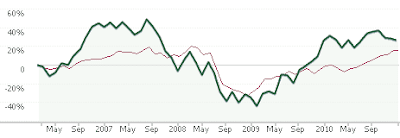
The stock is facing more competitive pressures and some segments are reaching maturity. Thus cable margins are near its peak, but cable telephony still has some potential. The cyclical recovery in the media advertising is also near its peak. Free cash flows are decreasing because of important capital investments in a 3.5G+ wireless network. Cash flows went from $321M in 2009 to $175M in 2010 (forecast). Mr. Ghose expects cash flows per share of $1.30 to $2.25 in 2011, $3.13 in 2012 and $4.11 in 2013.
Per Share Data QBR.B Industry
Earnings (TTM) $4.05 $1.89
Book Value $18.20 $17.97
Valuation
Price/Earnings 8.7x 15.4x
Price/Sales (FYR) 0.6x 1.6x
Price/Book (MRQ) 1.9x 2.6x
Price/Cash Flow (TTM) 2.3x 12.4x
Profitability (TTM)
Gross Margin 18.24% 9.94%
Operating Margin 33.77% 21.65%
Profit Margin 14.18% 8.09%
Mgmt Effectiveness (TTM)
Return on Assets 8.99% 6.77%
Return on Equity 26.87% 12.17%
Return on Investment 14.19% 8.39%
Dividend (TTM)
Annual Dividend Rate 0.20 0.64
Dividend Yield 0.57% 2.26%
Payout Ratio 0.1x 0.7x
Financial Strength (MRQ)
Debt to Capital 61.49% 29.28%
Current Ratio 1.0x 1.5x
Quick Ratio 0.7x 0.8x
Size
Market Cap $2.3B $1.0B
Revenue $3.8B $19.8B
Shares Outstanding 64.3M 631.3M
Employees 15,710 75,377
Mr. Ghose forecasts that Quebecor could increase significantly the dividend (actually $0.20$ per share) in 2012 and suggests a price target of $45. With an actual price of $34.90 it would represents a 29% return. The valuation measures compared to industry are much lower while profitability measures are higher. Furthermore, price the target of Mr. Ghose was made before two important press releases Quebecor this week.
1. Quebecor and its journalist ended a 2 years lock-out at Journal de Montréal, where the employer won important concessions from the employees (i.e. from 260 employees it would now be 62).
2. Since today, it is officially involve in the construction of a new arena in Quebec City where they will be the name sponsor and the manager of the building. They are betting on the acquisition of a NHL franchise and could made important benefits from events at the arena. Evenko, the event company of the Montreal Canadiens’ owners (Molson family) is making a lot of money in the second most used arena in North America (Bell Centre). The investment is $33M for the name without a hockey team and an annual rent of $3.15M or $63.5M with a hockey team and an annual rent of $5M.
With a better product portfolio of smartphones, Videotron (telephony division) will obtain more subscribers in the Canadian market, which is also one of the most expensive markets in the world for wireless packages. Cable telephony is still also in the growth stage. Investments in capital expenditures for the wireless networks is reducing Earnings per Share, but it is temporary.
Louis Rhéaume
Infocom Intelligence
Louis@infocomintelligence.com
Fundamentals
Market Cap 2.3B Beta 0.19
Revenue (FYR) $3.8B EPS (TTM) $4.05
Shares Out. 64.3M Book Value $18.20
Dividend Yield 0.57% P/E 8.7x
Div/Share $0.20 Price/Sales (FYR) 0.6
Ex-Div Date 11/24/10 P/Cash Flow (TTM) 2.3x
Pay Date 12/21/10 Operating Margin 33.77%
Data delayed at least 15 minutes.
Segmented Data: 12 months ended Dec. 31/09
Revenue by industry
News media: 27.2%
Leisure & entertainment: 8.1%
Interactive technologies: 2.4%
Broadcasting: 11.6%
Telecommunications: 52.9%
Head office & intersegment: -2.3%
Operating income by industry
News media: 15.6%
Leisure & entertainment: 2.0%
Interactive technologies: 0.3%
Broadcasting: 6.3%
Telecommunications: 76.2%
Head office & intersegment: -0.4%
Capital expenditures by industry
News media: 6.8%
Leisure & entertainment: 0.7%
Interactive technologies: 0.6%
Broadcasting: 3.3%
Telecommunications: 87.8%
Head office: 0.8%
Forecasts provided by Thomson Reuters I/B/E/S - Updated weekly
Consensus Recommendation of 13 Analysts Buy
Consensus Target Price of 13 Analysts $43.50
Dvai Ghose of Canaccord Genuity has a buy rating on the stock relying mostly on its medium to long term prospects.

The stock is facing more competitive pressures and some segments are reaching maturity. Thus cable margins are near its peak, but cable telephony still has some potential. The cyclical recovery in the media advertising is also near its peak. Free cash flows are decreasing because of important capital investments in a 3.5G+ wireless network. Cash flows went from $321M in 2009 to $175M in 2010 (forecast). Mr. Ghose expects cash flows per share of $1.30 to $2.25 in 2011, $3.13 in 2012 and $4.11 in 2013.
Per Share Data QBR.B Industry
Earnings (TTM) $4.05 $1.89
Book Value $18.20 $17.97
Valuation
Price/Earnings 8.7x 15.4x
Price/Sales (FYR) 0.6x 1.6x
Price/Book (MRQ) 1.9x 2.6x
Price/Cash Flow (TTM) 2.3x 12.4x
Profitability (TTM)
Gross Margin 18.24% 9.94%
Operating Margin 33.77% 21.65%
Profit Margin 14.18% 8.09%
Mgmt Effectiveness (TTM)
Return on Assets 8.99% 6.77%
Return on Equity 26.87% 12.17%
Return on Investment 14.19% 8.39%
Dividend (TTM)
Annual Dividend Rate 0.20 0.64
Dividend Yield 0.57% 2.26%
Payout Ratio 0.1x 0.7x
Financial Strength (MRQ)
Debt to Capital 61.49% 29.28%
Current Ratio 1.0x 1.5x
Quick Ratio 0.7x 0.8x
Size
Market Cap $2.3B $1.0B
Revenue $3.8B $19.8B
Shares Outstanding 64.3M 631.3M
Employees 15,710 75,377
Mr. Ghose forecasts that Quebecor could increase significantly the dividend (actually $0.20$ per share) in 2012 and suggests a price target of $45. With an actual price of $34.90 it would represents a 29% return. The valuation measures compared to industry are much lower while profitability measures are higher. Furthermore, price the target of Mr. Ghose was made before two important press releases Quebecor this week.
1. Quebecor and its journalist ended a 2 years lock-out at Journal de Montréal, where the employer won important concessions from the employees (i.e. from 260 employees it would now be 62).
2. Since today, it is officially involve in the construction of a new arena in Quebec City where they will be the name sponsor and the manager of the building. They are betting on the acquisition of a NHL franchise and could made important benefits from events at the arena. Evenko, the event company of the Montreal Canadiens’ owners (Molson family) is making a lot of money in the second most used arena in North America (Bell Centre). The investment is $33M for the name without a hockey team and an annual rent of $3.15M or $63.5M with a hockey team and an annual rent of $5M.
With a better product portfolio of smartphones, Videotron (telephony division) will obtain more subscribers in the Canadian market, which is also one of the most expensive markets in the world for wireless packages. Cable telephony is still also in the growth stage. Investments in capital expenditures for the wireless networks is reducing Earnings per Share, but it is temporary.
Louis Rhéaume
Infocom Intelligence
Louis@infocomintelligence.com
Monday, March 07, 2011
Skype will have a business model with advertising

Skype has just announced that they will provide occasional advertising to their subscribers.
Ads will be targeted only in the U.S., the U.K. and Germany at first. This would bring more revenue in preparation for a IPO (Initial Public Offering).
Skype says it has now 663 million subscribers and 8.8 million paid subscribers. Skype users made 207 billion minutes of voice and video calls during 2010, and in the fourth quarter, video calls accounted for approximately 42 percent of all Skype-to-Skype minutes. Furthermore, users sent more than 176 million text messages via Skype.
Revenues grew to $860 million for the year ended Dec. 31, up from $719 million in 2009 (combining the 2009 results of Skype pre-spinoff from eBay and post-spinoff). The company is still not making profit: it had a net loss of $6.9 million.
According to Skype's management their is a risk: "our users may respond negatively to receiving advertisements through their Skype software client, which could negatively and materially affect user engagement, our Skype brand and our results of operations.”
Skype admits that negative publicity around the temporary shut down of its network for a day (last year), might hurt its ability to launch a product targeting businesses: “As we increasingly introduce products particularly targeted at enterprise customers, for whom system stability is a critical factor, any system failures could have a significant impact on our ability to attract or maintain our relationships with enterprise customers.”
Source: http://newenterprise.allthingsd.com/20110307/skype-updates-its-pre-ipo-numbers-plans-to-sell-display-ads/
Louis Rhéaume
Infocom Intelligence
louis@infocomintelligence.com
Tuesday, October 12, 2010
Who is still the leader in smartphones?


Blackberry is still the most popular operating system (OS) platform for smartphones around the world with a presence in around 70% of firms in North America and Europe in Q1 2010. However, among consumers and business smartphones users, RIM is also the leader but is challenged by the growth of Android of Google. Even though Apple experienced fast growth with its iPhone, they lost a bit of market share between May and August this year. Finally, Microsoft just announced the launch of Windows phone 7 which resemble Android http://news.yahoo.com/s/ap/20101011/ap_on_hi_te/us_tec_microsoft_phones
Louis Rhéaume
Infocom Intelligence
louis@infocomintelligence.com
Tuesday, December 26, 2006
Canada is leading the Triple Play market

Pyramid Research estimates that nearly 42 percent of Canadian households will have a triple play subscription in 2006, up from about 30 percent at the end of 2005. Nearly 60 percent of Canadian households have some form of bundled services, a figure forecast to rise to more than 90 percent over the next five years. Such figures put Canada well ahead of such key markets as the US, France, and even South Korea, which will have triple play penetration levels at 8 percent, 4 percent, and 1 percent, respectively, at the end of 2006. The reasons behind Canada’s success are two-fold: market structure and providers giving customers what they want.
However, Pyramid Research don’t expect Canada to necessarily lead in the convergence stakes.
Canada’s dominant players are present across key market segments and are largely integrated operations. Bell Canada controls satellite DTH player Express Vu, and through it, nearly 20 percent of the Canadian Pay TV space. Likewise, Rogers Communications is present across segments. Taken together, Bell Canada, Rogers, and Telus control substantial portions of the segments critical to offering triple and quadruple play. To keep up, other players have had to accelerate their own evolution, with Telus launching IPTV, and cable players such as Videotron striking MVNO deals to offer mobile services. Another driver has been the role of regulation; Canada’s competition authorities have allowed some degree of cross-segment ownership, making it possible for players to be present across platforms.
Louis Rhéaume
Infocom Intelligence
infocom@videotron.ca
514-528-6422
Monday, December 18, 2006
Fixed-mobile convergence phones are coming soon to North America

British Telecom (BT) has launched FMC (Fixed-mobile Convergence) phones tailored for SMEs. It means that GSM mobile phones can be used in UK at the price of a wireline phone at home because of WiFi capability. Eventually they will be available at other Wifi hotspots in Britain and around the world in GSM countries like Canada (Rogers's network). These phones will enable cheap phone calls and wireless Internet access in places such as homes with WiFi networks/routers, business locations, airports, railway stations, hotels, bars, restaurants, and foreign countries WiFi hotpots.
Also available free is Call Minder Multi, BT’s smart messaging service, which combines the customer’s mobile and landline voicemail, giving them only one mailbox to call to pick up all their messages.
These popular Wifi FMC phones will be probably available in Canada by 2007-2008 and across the world.
http://www.btplc.com/News/Articles/Showarticle.cfm?ArticleID=81e3a4df-56bc-4005-b964-1389d8612c23
Louis Rhéaume
Infocom Intelligence
infocom@videotron.ca
514-528-6422
Saturday, November 11, 2006
Investing opportunities in telecommunications in Latin America
Latin American Mobile Subscribers Grow 85% Year-on-Year According to the GSM industry association of 3G Americas. The GSM mobile technology subscriber headcount in Latin America reached 192 million at the end of the 3Q 2006, up 85 percent compared to the same time a year ago.
In Canada, many wireless operators have never invested outside Canada. Only BCE with Bell Canada International (BCI) has invested in wireless subsidiaries outside Canada. BCI was finally dismantled in 2003. The creation of value at BCI has been a big disappointment. Other Canadian operators maybe have been influenced by the performance of BCI and have not invested in foreign assets. However, many European operators have invested in foreign assets like Vodafone, Telenor and Orange with some success.
Latin America represents a very interesting region to invest in wireless assets. In many areas, wireless is a valid option to wireline, at an attractive price now. Individuals can participate in the growth of wireless Latin America businesses by investing in ADRs (Foreign firms traded at American stock exchanges in US $ currency) or ETFs (exchange traded funds). For instance, iShares S&P Latin America 40 - (ticker: ILF) invests 22% of its assets in telecom assets in Latin America
Top 10 Industry Sectors as of 03/31/05
Materials 26.05%
Telecommunication Services 21.96%
Financials 15.06%
Consumer Staples 13.37%
Energy 12.70%
Industrials 4.10%
Utilities 3.40%
Consumer Discretionary 3.18%
S-T Securities 0.17%
Total 100.00%
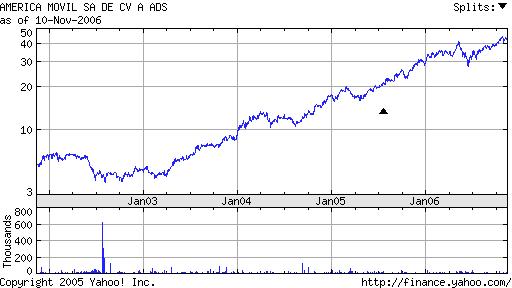
An investor can also invest directly in wireless firms in Latin America through ADRs, like America Movil, S.A. de C.V. - Class A American Depositary Shares (ticker: AMOV) . The graph at the top told us that AMOV had a return of over 600% in 5 years.
Last Sale:$ 42.50
P/E Ratio: 26.23
Shares Outstanding: 37,600,000
Earnings Per Share (EPS): $ 1.62
Market Value: $ 1,598,000,000
Louis Rhéaume
Infocom Intelligence
infocom@videotron.ca
www.infocomintelligence.com
Wednesday, October 25, 2006
You want to know the difference ICTs have made?

Try to live without them...
The difficulty of measuring General Purpose Technologies
Like electrical power before it, ICTs have been recognized as a "General Purpose Technology" (GPT) that transforms economic relations, enhances productivity and creates new services and markets. GPTs have the following three characteristics:
Pervasiveness: GPTs spread to most sectors. This suggests that impacts should be measured at a higher level than the firm or disaggregated sectors. Higher levels of aggregation internalise the externalities or spill-over impacts that arise at low levels of aggregation.
Improvement: GPTs get better over time and, hence, should keep lowering the costs of its users. In fact, one of the problems associated with the study of ICTs is that they are constantly evolving. Apart from making quality adjustments for improvements in current technology, new technologies will emerge. ICTs are a moving target.
Innovation spawning: GPTs make it easier to invent and produce new products or processes. That is, they allow us not only to do things better but to do better things. New possibilities are created and specialization raises productivity.
This is an excerpt from the :
WORLD TELECOMMUNICATION/ICT
DEVELOPMENT REPORT
Measuring ICT for Social and Economic Development, 2006
Another example of the impact in the usage of ICT in our life: the way some people are using their smartphone. Some users bring them in their bedroom to stay connected 24h per day....
Louis Rhéaume
Infocom Intelligence
www.infocomintelligence.com
infocom@videotron.ca
Subscribe to:
Posts (Atom)