Le Dr. Yvan Allaire pousse plus loin la réflexion sur la stratégie de convergence de BCE, qui a été discuté samedi sur Seeking Alpha.
Il affirme que les entreprises fondées sur un actionnariat familial et un contrôle via des actions à vote multiples, comme Rogers Communications et Quebecor ont plus de latitude pour mieux exécuter une stratégie de convergence.
Voir: http://www.lesaffaires.com/blogues/yvan-allaire/bell-canada-et-la-saga-de-la-convergence/542307
Pour notre article sur la stratégie de convergence de BCE voir:
http://seekingalpha.com/article/440281-bce-relies-again-on-a-convergence-strategy
Louis Rhéaume
Infocom Intelligence
louis@infocomintelligence.com
Twitter: @InfocomAnalysis

A blog on the convergence of info-communications industries: communications, computing, electronics, entertainment, publications and education. Strategic, technological and financial analysis. English and French blog. Cette chronique traite de l’évolution des industries de l’information et des communications et couvre des aspects stratégiques, technologiques et financiers, comme l’économie du savoir et de l’innovation. L’auteur est Associé principal de Infocom Intelligence.
Showing posts with label convergence. Show all posts
Showing posts with label convergence. Show all posts
Tuesday, March 20, 2012


Saturday, March 17, 2012
New article on Seeking Alpha: BCE relies again on a convergence strategy
Our new article is available on Seeking Alpha: "BCE relies again on a convergence strategy".
http://seekingalpha.com/article/440281-bce-relies-again-on-a-convergence-strategy
Louis Rhéaume
Infocom Intelligence
louis@infocomintelligence.com
Twitter: @InfocomAnalysis
http://seekingalpha.com/article/440281-bce-relies-again-on-a-convergence-strategy
Louis Rhéaume
Infocom Intelligence
louis@infocomintelligence.com
Twitter: @InfocomAnalysis
Wednesday, December 07, 2011
New article on Seeking Alpha: Quebecor: an information and communications convergence play
My new article is available on Seeking Alpha: "Quebecor: an information and communications convergence play".
http://seekingalpha.com/article/312432-quebecor-an-information-and-communications-convergence-play
Louis Rhéaume
Infocom Intelligence
louis@infocomintelligence.com
Ywitter: @InfocomAnalysis
http://seekingalpha.com/article/312432-quebecor-an-information-and-communications-convergence-play
Louis Rhéaume
Infocom Intelligence
louis@infocomintelligence.com
Ywitter: @InfocomAnalysis
Monday, October 17, 2011
Infocom convergence war: Apple vs Google vs Facebook vs Amazon
The magazine Fast Company discusses this month the actual infocom war which oppose 4 corporate titans involved in many infocom sub-sectors. CNBC made an interview with the editor-in-chef.
It appears that very recently you could describe these 4 titans in few words: Apple did consumer electronics. Google did search, Amazon a web store and Facebook a social site. Each tech titan pushing further into mobile tablets, apps, cloud data and beyond. Fast Company offers four scenarios where each titan could emergence as a big winner of this tech war.
"In some ways their competition with each other will continue to elevate them ahead of the rest of the pack, but their actions and their ambitions are driving them into each other's areas. whether that's Google launching a social network, Amazon launching an ipad competitor, these companies are definitely looking for the same larger opportunities in mobile and media and data. and that's driving them into each other's areas. You know, at the same time they are setting the agenda for wide swaths of the rest of the economy. it's other folks who are forced to respond and react to what these guys are doing... I think the question here for investors is where will the profits go? right now apple is in the driver seat in terms of how big their profits are, the cash they're generating, the growth we're seeing from them.
But to put it in retail terms, this is like a battle between the Nordstrom, Walmart and Target models. i put Apple in the Nordstrom category, Google and Facebook are more Walmart. You sort of trade convenience for a little bit more of an open ecosystem but doesn't work quite as well. and Target is more of Amazon's model. They're really selling commerce, all these other things are feeding you into buying things from Amazon. I think that's the real issue is which one of those models wins out. I think they're all at slightly different life stages too. amazon ig@ on track to be the fastest company to reach $100 billion in revenues projected by I think 2015. That's tremendously fast."
"At the same time as you mention, Apple is making so much money and i think it takes apple about nine days to generate what Facebook generates in a year in revenue. But Facebook does have 800 million customers, right? users, and they have data from those folks on what they like and how they end up using that data may be tremendously valuable in the years ahead... How do you define actually winning? is it the amount of money they make, their entrepreneurship and innovative skills or the products they put out. or is it all of that? certainly from an investing point of view making money's important."
http://video.cnbc.com/gallery/?video=3000051097
Louis Rhéaume
Infocom Intelligence
louis@infocomintelligence.com
It appears that very recently you could describe these 4 titans in few words: Apple did consumer electronics. Google did search, Amazon a web store and Facebook a social site. Each tech titan pushing further into mobile tablets, apps, cloud data and beyond. Fast Company offers four scenarios where each titan could emergence as a big winner of this tech war.
"In some ways their competition with each other will continue to elevate them ahead of the rest of the pack, but their actions and their ambitions are driving them into each other's areas. whether that's Google launching a social network, Amazon launching an ipad competitor, these companies are definitely looking for the same larger opportunities in mobile and media and data. and that's driving them into each other's areas. You know, at the same time they are setting the agenda for wide swaths of the rest of the economy. it's other folks who are forced to respond and react to what these guys are doing... I think the question here for investors is where will the profits go? right now apple is in the driver seat in terms of how big their profits are, the cash they're generating, the growth we're seeing from them.
But to put it in retail terms, this is like a battle between the Nordstrom, Walmart and Target models. i put Apple in the Nordstrom category, Google and Facebook are more Walmart. You sort of trade convenience for a little bit more of an open ecosystem but doesn't work quite as well. and Target is more of Amazon's model. They're really selling commerce, all these other things are feeding you into buying things from Amazon. I think that's the real issue is which one of those models wins out. I think they're all at slightly different life stages too. amazon ig@ on track to be the fastest company to reach $100 billion in revenues projected by I think 2015. That's tremendously fast."
"At the same time as you mention, Apple is making so much money and i think it takes apple about nine days to generate what Facebook generates in a year in revenue. But Facebook does have 800 million customers, right? users, and they have data from those folks on what they like and how they end up using that data may be tremendously valuable in the years ahead... How do you define actually winning? is it the amount of money they make, their entrepreneurship and innovative skills or the products they put out. or is it all of that? certainly from an investing point of view making money's important."
http://video.cnbc.com/gallery/?video=3000051097
Louis Rhéaume
Infocom Intelligence
louis@infocomintelligence.com
Monday, November 08, 2010
BCE strategy revisited

The good strategic realisations
Bell Expressvu DTH service has been a great success for BCE. It is a key element in the bundling of the « triple play » which is the combination of voice, data and video through a sole provider (cable or telco). The triple-play is becoming increasingly important:
« Coincident with the ability of the copper and coax networks to carry non-traditional services, customer needs are also evolving around three key services: voice (wireline and wireless), video and data. While some customers will prefer to select service providers on an individual basis based on a “best-of-breed” approach, many individuals have a clear preference for simplicity and low price. Perhaps ironically, the most important service is increasingly becoming the broadband connection. Operators with the ability to provide this triple-play offering (increasingly as part of a bundled offering) should have a decided advantage over those without. The benefits for the operator are:
(1) Enhanced revenue and cash flow generation per customer; and,
(2) Reduced customer churn and improved loyalty levels.
As a result, overall growth and visibility should improve. Those operators without the ability to offer a triple play, should consider partnerships and/or alliances (Talbot, RBC[1])».
The wireless division was the first in the industry to become free cash flow positive[2] around 2002. Another important strategic realisation was the building and development of Sympatico, the Internet arm of BCE. The company was slow to enter the dial-up Internet provider access. Several little dial-up providers have flourished over the years, before Bell entered the market in November 1995. However, during this period, Bell made a lot of money from the new dial-up services of the small providers. Residential and business customers who used often the Internet needed a second telephone line, which increased the profits of Bell. It is one of the main reasons why Bell and the majority of telcos, were late in the race for high-speed Internet over cable providers such as Videotron. It acquired TotalNet a growing Internet access provider, with its investment in Mpact Immedia (merged with BCE Emergis) in 1998.
Previous CEOs of BCE have started to reduce the overlapping in the activities between BCE and Bell Canada. Jean Monty made some improvements in this area of cost-cutting and after, Michael Sabia reduced management staff between Bell Ontario and Bell Quebec. A clever strategic move during the reign of Monty has been the excellent timing for the spin-off to the BCE shareholders of the shares of the holding in Nortel. The spin-off was done around the peak of Nortel in 2000 before it crashed by over 95%. For Richard Talbot of RBC, it was a tough decision to do at this time but it was the right thing to do. Among the others good realisations there are the investments in Bell Nexxia to compete the ex-Stentor member alliances, which help Bell to retain customers according to Talbot and the investments in Manitoba Telecom and Aliant (the consolidation of the Atlantic regional operators).
The strategic errors
The wedding between the local services and the long-distance services appeared to be just an extension of the core activities of Bell. Thus, a participation in Teleglobe with finally its acquisition in 2000, was not very surprising. However, Teleglobe’s acquisition was the idea of Monty. Monty wanted to transform BCE from a Canadian telephony player into a global “Internet firm” through connectivity, commerce and content and by integrating information, communication and entertainment services. With his background of investment banker, he maintained good relationships with this sector, in order to get advices for potential business target prospects. Teleglobe was the nemesis of Jean Monty. The acquisition turned in a disaster, Bell managers were « pitchfork » to Teleglobe, and tried some risky data projects which didn’t get tangible customers. The Excel division was in a real mess and was divested at a fraction of its acquisition price paid by Sirois. BCE poured billions of dollars inside Teleglobe mainly for its data strategy, until it pulled the switch with Monty’s resignation. It appeared that the value of Excel divestment would even be higher than the value that BCE would get for its divestment of Teleglobe, to Cerberus Capital Partners in 2002. A negative consequence of the problems of BCE with Teleglobe, have been the divesting of a very profitable cash flow generating subsidiary: the directory division Bell Actimedia (Yellow-Pages).
At its inception, Bell Canada International was the vehicle of BCE to export its specialised telecommunications know-how internationally, like in Saudi Arabia. In the beginning of the 1990’s, there was an emerging globalisation movement where several players like the Baby Bells in the USA invest massively in privatisation bids in order to get international foothold, and diversifying the risk of intense competition in their local and long-distance domestic markets[3]. There was a investment frenzy similar to the recent bubble associated with the prospects of 3G cellular licenses internationally. Over-bidding was often seen, since the firms who didn’t win a series of bid had strong pressures to finally win a bid. According to Richard Talbot, BCI created a lot value, but the exit strategy of these international investments was poorly managed, and that value was never cristallized, unlike the spin-off of Nortel shares. It hurted badly the reputation of BCE on financial markets since many lawsuits were launched in the closing and divesting of BCI.
The mixed successes
In order to better position itself in the content and distribution sector, Monty acquired the broadcaster CTV for $2.3 billions, ten days after the acquisition of Teleglobe in February 2000. Another important investment, was made with Thomson in the Globe and Mail, which strengthened the new division Bell Globemedia. Sympatico was also added but later separated from this division, raising the expectations over a sale of some of its assets. Owning the content of the Globe and Mail permits for example for BCE to make special distribution agreements with its other subsidiaries such as Bell Mobility on its wireless devices. However, critics argue that BCE could pay monthly subscription fees to access this content instead of owning theses highly paid assets. These two major investments were made during the stock market bubble.
The repurchase of the 20% investment of SBC in BCE in 2002 appears like a failed attempt for synergies with the American operator, but the timing (sold during the correction phase of 2002) seems good since the stock of BCE is still facing turbulence and is expected to rebound moderately in the future, meaning that the repurchase could have been even more expensive. The cash infusion for BCE helps the firm to complete the repurchase of the public shares in BCE Mobile. Bell ended its relationship with Lycos, which obtained mixed results. The company switched to select a new partner, the colossal Microsoft MSN.ca, for the development of a joint Canadian Internet portal in 2003[4].
According to Richard Talbot of RBC, a questionable tendency at BCE have been deals where they have ceded major control of power, by giving put options to partners. Thus, deals such as CGI where the power was heavily concentrated in the hands of the three founders while they possess few shares of the company is an example. The put option of SBC in its 20% investment of BCE was very expensive to repurchase, and so was the investment in Bell West with Manitoba Telecom.
Important value creation and corrections
Two investments made over the reign of Jean Monty created a lot of value, but was also seriously affected by the crash of the dot.com bubble: CGI and BCE Emergis. However, CGI was first the idea of Louis Tanguay the CEO of Bell Canada, who got a call from Serge Godin of CGI[5]. The 26% participation of BCE in CGI for $18.4 million in 1995 would become a very profitable investment since CGI revenues were only $100 million (revenues will be around CAN$4 billion in 2005). Bell Sygma was merged after with CGI and the participation increased to 44% (under press at March 2004, the participation is now 29.5% due to the shares issuance of the acquisitions), with the goal that customers need more integrated package of computing and telecommunications solutions.
BCE decided to not use its option to become the majority shareholders and buy more shares of CGI. The company brought around $200 millions directly in contracts to BCE[6]. A strategic option could be similar to the former relationship with Teleglobe: BCE could sell its position in the long term while maintaining a « preferred supplier » relationship with CGI for its telecommunications needs. The synergies between computing and telecommunications services didn’t appear much attractive for BCE: Sabia later sold BCE’s investment in CGI.
BCE invested $100 millions to acquire Mpact Immedia in two rounds of financing, and merged its activities with Bell Emergis[7]. The combined company had revenues of $75 millions in 1998 and $316 million in 2003 ($346 millions in 2002). CGI has now a market capitalisation of $3.1 billion and BCE Emergis $593 millions, at March 27, 2004. However, these investments have consumed a lot of management time at BCE recently.
Sabia divested Emergis and Monty later became involved on the board of directors.
The reactions over BCE convergence strategy
The financial market was first receptive with the diversification moves of Jean Monty, which goes in line with some academic research[8]. However, the perception of the stock market and the business press changed dramatically with news such as the big write-offs of AOL Time Warner and Vivendi Universal. The Canadian press was quick to critic the convergence acquisitions of Monty for the reason behind the turbulence of the stock. Monty mentioned himself, that he had mainly a problem of credibility with his decisions to buy and further invest massively in Teleglobe, which pushed him to resign. The convergence strategy of combining several forms of information inside an information sector such as content and highways appears recently promising for a company such as Quebecor. Innovation capacities, cross-selling and cross-promotion takes some time to implement and project such as Star Académie seems to demonstrate that convergence at this scale can create value. According to Kona Shio, financial analyst, the business community didn’t not let Monty the time to execute properly his strategy (he himself mentioned the need to wait for two years), they wanted results in the short term, while the economic context was tough. For Dr. Yvan Allaire, Emeritus professor of strategic management at University of Quebec at Montreal :
« la démission de Jean Monty, prouve que la stratégie de convergence doit encore composer avec des difficultés d'exécution redoutables. Au début d’une période de turbulence [comme le décloisonnement des services financiers] , il est presque impossible de prévoir comment les comportements des acheteurs seront modifiés par le nouveau contexte et quelle sera la demande véritable pour les nouveaux services et, en fait, quels services parmi toute une gamme de possibilités recevront la faveur des acheteurs. À ce jour, la convergence dans le secteur des médias/télécommunications/ câblodiffuseur/Internet demeure un pari voulant que les bénéfices d'une offre intégrée auront une valeur économique réelle pour les acheteurs/consommateurs. Certains dirigeants souffrent de presbytie en ce que l'impact des changements en cours leur semble plus immédiat, plus rapproché qu'il ne l'est en réalité. Ces nouveaux marchés, conséquences des nouvelles technologies, que ces dirigeants voient si distinctement, seront bien réels mais un jour plus lointain. Ainsi, la convergence, il n'y a pas de doute, produira éventuellement de nouvelles combinaisons de services et produits; l'enjeu pour les entreprises est d'apprécier selon quel horizon temporel cela se produira. D'autre part, les bénéfices de la convergence seront réalisés en longue durée; or, les marchés boursiers, pourtant si enthousiastes à une époque récente, s'impatientent et perdent rapidement confiance dans cette stratégie. La suite est prévisible. Il est tellement facile après coup d'être sage et omniscient. Ces hommes d'action ont voulu transformer leur entreprise afin de saisir de nouvelles opportunités de marché. C'est un paradoxe de la vie des organisations que les fautes d'omission sont rarement punies alors que les fautes de commission reçoivent de dures sanctions. »
One error of the convergence vision could have been to focus too much on acquisitions to put in place the convergence in the info-communications sector. BCE could have tried more alliances and partnerships at lower costs than acquisitions, while leveraging and not stretching too far the centre of gravity of its core competencies. The international activities of BCE have been a disaster since BCI is liquidated all its assets and Teleglobe felt in bankruptcy. However, a promising development of the convergence strategy could be the triple play, the ability of BCE to offer 3 or 4 types of services to its existing customers, while reducing its churn. That opportunity could create a lot of value for its shareholders. Sabia even discarded the over-used term “convergence” from his communications with financial analysts.
At June 1998, the international activities of BCE: Nortel, Bell Canada International and Teleglobe consisted of half of its market value. In 2004, Nortel was no more related to BCE, BCI is divesting all its assets (some with profits) and Teleglobe assets were sold at a small fraction of its purchase after falling in bankruptcy.
Under Michael Sabia, BCE has retired from some activities and started new products linked to the Internet[i]. The company faces some challenges particularly in its business division while the residential performs well. BCE later announced an aggressive decision to use around 90% of its traffic with VoIP, up to 2006. The aim was to save in the operating costs and to offer new high value services. Furthermore, the Internet platform would be dereglemented which would let more flexibility in the strategy of BCE. The company intend to build a quick lead in order not be bypassed by competitor such as Primus or Vonage Phone in the retail, or Allstream in the business sector.
According to Sabia : « BCE is living in a time where innovation, simplicity and speed are now very critical… we are dealing with an identity crisis, the market doesn’t understand us anymore. Who are we? In the past the company focused too much on technology and products and not enough on customers… Changing the culture of a company takes many years, but I am not a patient man.[ii] »
New trends
Still, today under CEO George Cope, the shares of BCE remains a solid “market performance” investment with the recurrent cash flow from operations of Bell Canada particularly, and the fact that the dividend yield is among the highest of the Toronto Stock Exchange. However, BCE rely heavily on the project fibre-to-the-home (FTTH) in Québec City, and Bell’s Fibe TV service for interesting growth in revenues and profits in the future. The stock has increased in the last year mainly due to the rise of its dividend, and cost savings, which is not a long term sustainable value creation avenue. Last month BCE just bought again CTV, after it was divested by Sabia. BCE is paying $1.3 billion plus debt, for full control of the company. BCE currently owns 15 per cent equity in CTV. It is the first move of BCE toward convergence since the departure of Jean Monty.
Louis Rhéaume
Infocom Intelligence
Louis@infocomintelligence.com
[1] RBC report, Richard Talbot, January 27, 2004, « Canadian Telecom Services, Battle For The Broadband Home ».
[2] Cash flow of the firm less capital expenditures, which are very high for the upgrade of wireless networks.
[3] ANNE D. SMITH, Anne and CARL ZEITHAML, « The Intervening Hand Contemporary International Expansion Processes of the Regional Bell Operating Companies », JOURNAL OF MANAGEMENT INQUIRY, Vol. 8 No. 1, March 1999, pp. 34-64
[4] Fortin, Karine , Le Devoir June 17, 2003, « Bell et Microsoft créeront un portail Internet conjoint »
[5] Jannard, Maurice, « Bell Canada investit 18,4 millions dans CGI », La Presse, October 27, 1995
[6] Bérard, Diane, «La partie d'échecs de Sabia », Commerce, Vol: 104 No: 4, April 2003, p. 46
[7] Jannard, Maurice, « Bell Canada fait l'acquisition de MPACT Immedia », La Presse, June 5, 1998, p. c4; Paquin, Guy, «BCE assoit son contrôle d'Emergis... à prix d'aubaine », Les Affaires, January 30, 1999, p. 58
[8] Rhéaume, Louis, 2000, « Value creation in evolving information industries : the effect of US mergers ». M.Sc thesis, Concordia University. The author reports that contrary to most of the research analyzing the overall industries, bidders of mergers inside the information industries (composed of three sectors : content, appliances and highways) obtained positive returns in the short term. Thus, the market response appeared favorable to those mergers, few days around the announcement, whether it is a highly related or a highly unrelated mergers (on average), but still inside the information industries : communications, publishing, electronics, computing and entertainment.
[i] Canadian Press, « Michael Sabia n'est pas inquiet, les revenus et les profits de BCE sont en baisse », Le Devoir, February 5, 2004
[ii] Vailles, Francis, « Bell prend le virage de la téléphonie Internet Le bénéfice augmentera de moins de 10% », La Presse, December 18, 2003; Bérard, Diane, « La partie d'échecs de Sabia », Commerce, no. Vol: 104 No: 4, April 2003, p. 46
Wednesday, November 03, 2010
AOL versus Time Warner, what is left?


I began to study "mergers and acquisitions of convergence" in the information and communications industries, 6 months before it became a hot topic in the media, with the merger of AOL with Time Warner (deal announced January 10, 2000). After this transaction the term "mergers and acquisitions of convergence" became widely popular and several M&A followed in few years, making combinations of content with pipes: i.e. Vivendi and Universal, Quebecor and Videotron, BCE and CTV and Globe & Mail, etc.
According to Wikipedia: Time Warner (formerly AOL Time Warner) is the world's second largest entertainment conglomerate in terms of revenue (behind Disney and ahead of News Corporationand Viacom), as well as the world's largest media conglomerate. Formerly two separate companies, Warner Communications, Inc. and Time Inc., (along with the assets of a third company, Turner Broadcasting System, Inc.) form the current Time Warner, with major operations in film,television and publishing. Among its subsidiaries are New Line Cinema, Time Inc., HBO, Turner Broadcasting System, The CW Television Network, TheWB.com, Warner Bros., Kids' WB,Cartoon Network, Boomerang, Adult Swim, CNN, DC Comics and Castle Rock Entertainment.
What was the value creation of AOL and Time Warner? In December 2009, Time Warner made a spin-off of AOL and they became two distinct firms. You can see in the second chart that AOL-TimeWarner destroyed a lot of value for its shareholders, and after the spin-off, Time Warner started a recovery. The share of AOL is almost at the same level of the day of the spin-off, one year ago.
The recent quarterly results of Time Warner showed that the firm raised its 2010 profits growth target from 20% to high 20s. It appears that they had solid advertising and subscription growth. New technologies appliances such as smartphones and iPad has helped to increase the demand of its content. The new Harry Potter movie will start in November 19. In publishing, the firm faced lower subscription levels but made big cost reductions.
The recent quarterly results of AOL showed that the company is deeply restructuring and in massive divesting of unsuccessful assets such as: ICQ messaging, travel website Kayak and social network Bebo. They newly redesigned web sites such as the portal www.aol.com, MapQuest and AOL Travel. While, their advertising revenues has dramatically dropped from 27%, eMarketer estimates that overall advertising spending grew around 12% compared to Q3-2009. The firm hopes that its new advertising system will create important shareholders' value. One growth avenue resides also on selected M&A. They bought recently the tech blog TechCrunch for $25M and 5min Media, which is a syndication platform for lifestyle, knowledge and instructional videos for $65M.
Sources: Yahoo news, Bloomberg, Wikipedia.
For more information on M&A of convergence see
http://infocomanalysis.blogspot.com/2008/06/article-convergence-mergers-and.html
Louis Rhéaume
Infocom Intelligence
louis@infocomintelligence.com
Wednesday, June 04, 2008
Article Convergence mergers and acquisitions published in Information & Management

An article concerning the convergence of mergers and acqusitions in the info-communications industries will be published in the new issue of the scientific journal Information & Management Volume 45, Issue 5.
Notre article sur la convergence des fusions et acquisitions dans les industries de l'info-communication va être publié dans le prochain numéro du journal scientifique Information & Management Volume 45, Issue 5.
Value creation in information-based industries through convergence: A study of U.S. mergers and acquisitions between 1993 and 2005In Press, Corrected Proof, Available online 29 May 2008, Louis Rhéaume, Harjeet S. Bhabra
A B S T R A C T
According to the International Engineering Consortium (IEC), the realignment and consolidations currently underway in information-based industries is likely to result in the five traditional information industries (photography, publishing, computing, telecommunications and entertainment) converging into three new sectors: information content providers, information highways, and information appliances. We investigated the impact of mergers and acquisitions on value creation both within and across these sectors by estimating the stock market’s response to acquiring firms around the announcement date of their merger. Using data on 2421 mergers and acquisitions between 1993 and 2005 and employing the well-established event study methodology, we found that most acquirers received a target within the same sector or industry and that the related acquisition strategies brought synergistic gains resulting in positive wealth change for the acquiring firm’s shareholders. The few firms that pursued an unrelated diversification strategy that lowered operating risk experienced no significant change in shareholder wealth. Our results contrasted with the zero or negative wealth change found for
acquiring firms in general (as reported in the finance literature) but were consistent with the positive wealth change for acquirers in the telecommunications industry found in recent studies.
Wednesday, December 06, 2006
The impact of technological convergence
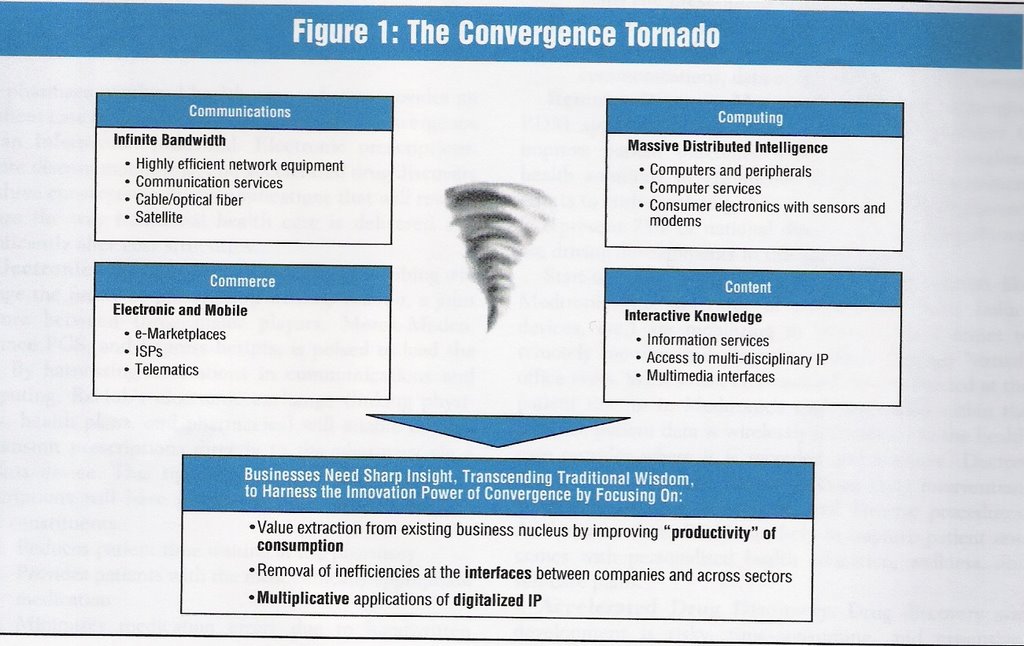
Technological convergence is occuring in technology products, services and platforms. Adventis argues that branding, bandwidth and business models are the new triangle to deal with this dynamic. Thus, there is a migration value to knowledge-intensive layers of the infocom value chain. Processes such as information transport are becoming commodities. There are not a lot of value creation at the transport division of AOL, but more in the content portal and Internet services division.
The innovation dynamics depend on the abilities to:
- Develop and monetize intellectual property through customized value packets that in turn enhance the yield of investments in knowledge
- Access low-cost manufacturing centers of the world (i.e. Taiwan in semi-conductors, India for software engineering)
- Create an environment that continually enables customers apply intellectual property to make more effective use of products
Louis Rhéaume
Infocom Intelligence
infocom@videotron.ca
514-528-6422
Ghosh, Patricia, "Technological convergence is transforming business models, and new digital paradigms are emerging", Journal of Business Strategy
Sunday, October 15, 2006
Suivre le troupeau n'est pas toujours bon en stratégie: le cas BCE


BCE vient d'annoncer qu'elle va se réorganiser et laissé de côté l'entité corporative de BCE en fusionnant ses unités avec Bell Canada en formant une fiducie de revenu. Il est vrai que les sociétés de portefeuille qui ont des unités très diversifiées font face à ce qu'on appelle le portfolio discount , c'est-à dire que la valeur marchande du conglomérat dans une entité regroupée (BCE par exemple) vaut moins que la somme de chacune des entités vendu séparément. Cette escompte est plus importante quand les unités sont très peu liées entre elles. Dans le cas de BCE, les entités Bell Globemedia, Bell Canada, CGI avaient un certain lien entre elles et on ne pouvait parlé de diversification hautement non reliée. Il s'agissait plutôt de diversification faiblement reliée dans le secteur des réseaux (téléphonie, avec informatique et télédiffusion ) et du contenu (poste de télé, site webs, journaux). Jean Monty avait lancé l'idée que ces unités pouvaient développées des synergies entre elles et créer plus de valeur de façon regroupée que de façon indépendante. Cette idée n'a pas vraiment été développée ou poursuivie par son successeur et BCE a commencé à vendre plusieurs de ses investissements: une partie de Bell Globemedia, de CGI, de Emergis.
Or, son principal concurrent Telus, décide tout récemment de se convertir en fiducie de revenu. L'action augmente beaucoup, la compagnie paiera ainsi moins d'impôt. L'action de BCE qui fait du sûr place depuis 4 ans prend alors plus de valeur en conséquence de cette décision: plusieurs investisseurs anticipent la même chose pour BCE. À court terme, il est vrai que le traitement fiscal des fiducies de revenu fait en sorte que les actionnaires semblent gagnant à court terme: ils vont finalement payer moins d'impôt. Cependant, plusieurs analystes, (dont Stephen Jarislowski) affirment (et je partage cet avis) qu'une compagnie qui se transforme en fiducie de revenu perd beaucoup de son autonomie stratégique et réduit considérablement sa croissance à long terme. Pourquoi? Et bien en se convertissant en fiducie de revenu, BCE va devoir verser une très grande partie de ses bénéfices en dividende à ses actionnaires. BCE a un dividende très élevé qu'elle a de la difficulté à maintenir présentement ou à le faire croître. Or, en versant maintenant une plus grande partie de ses bénéfices en dividendes, la compagnie aurait définitivement moins de marge de manoeuvre pour contrer la concurrence et investir dans son avenir puisqu'elle aura moins de bénéfices non répartis. Les concurrents comme Rogers Communications et Québécor/Vidéotron qui n'auront pas choisi la voie de la fiducie de revenu pourront bénéficier de plus de flexibilité financière et d'autonomie stratégique. Ils auront plus d'argent pour investir dans des nouveaux produits et services et faire l'achat de compagnies complémentaires à leur portefeuille d'unités.
Comme quoi résister à la tentation et ne pas suivre le troupeau est une option stratégique qui peut être très payante à long terme.
Louis Rhéaume
Infocom Intelligence
infocom@videotron.ca
www.infocomintelligence.com
Sunday, September 03, 2006
Comment profiter de la convergence: les différents types de convergence, les types de consommateurs et les modèles d'affaires.
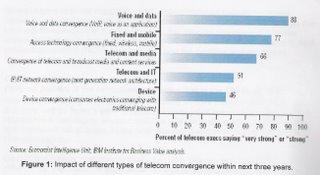
Un récent rapport de IBM donne quelques pistes intéressantes comment profiter des différents types de convergence. Il en ressort que certains types de convergence exercent des pressions plus fortes dans l'industrie des info-communication.

Louis Rhéaume
Associé Principal
Infocom Intelligence
www.infocomintelligence.com
Inspiré du rapport de Carlson, Jeanette; Chris Woodland and Henry Stevens, "Profiting from convergence: defining growth paths for telecom service providers", July 2006, Vol. 2, IBM
Un récent rapport de IBM donne quelques pistes intéressantes comment profiter des différents types de convergence. Il en ressort que certains types de convergence exercent des pressions plus fortes dans l'industrie des info-communication.
Tout comme l'industrie de l'informatique, l'industrie des télécommunications est en train de se désaggréger. Autrefois, l'ordinateur était concû en entier par un fabricant qui était intégré verticalement. Ainsi, tout était fabriqué par la même firme: système d'opération, logiciel, composantes électroniques. Apple et IBM ont commencé à intégrer des firmes complémentaires qui ont fourni des produits et services à meilleur prix et meilleur qualité. Microsoft a obtenu le contrat du sytème d'exploitation du PC de IBM et Intel a fourni le microprocesseur. Aujourd'hui, IBM a abandonné la fabrication de PC aux mains du chinois Lenovo puisque ses marges étaient très faible dans le secteur manufacturier. La grande valeur ajoutée dans la chaine de valeur de l'informatique s'est développé aux extrémités, soit le système d'exploitation et le microprocesseur.
Il est en train de se passer une situation similaire avec les télécommunications. Le transport de données se fait à des prix très bas tandis que les firmes aux extrémités de la chaîne de valeur profitent grandement de l'Internet comme Skype et les fournisseurs de contenu.
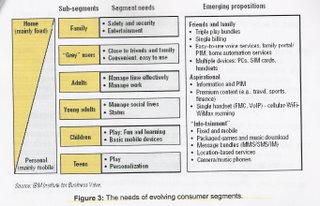
Un facteur clé de création de valeur est le focus de types de clientèle. Dell a révolutionné il y a 20 ans la vente d'ordinateur en privilégiant le service direct à des clients plus sophistiqués et expérimentés dans l'achat d'ordinateur sur-mesure. En télécommunications certains segments ont des besoins assez différents.
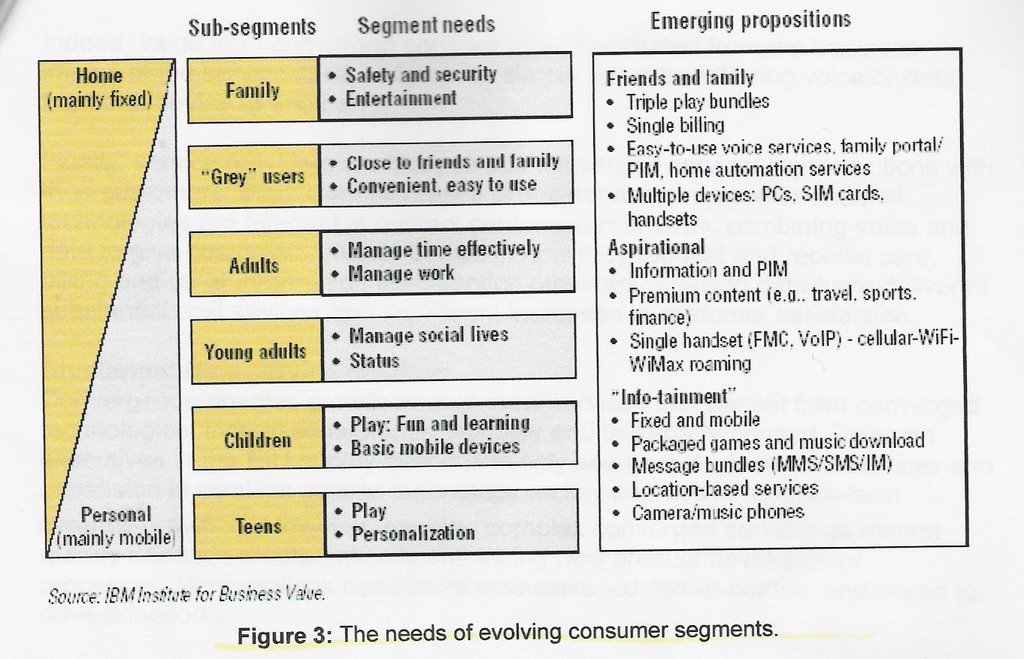
Le choix du focus de clientèle fait en sorte que la firme peut se spécialiser et renforcir ses compétences stratégiques pour mieux répondre à ce type de clientèle. Il en ressort que les firmes peuvent innover en offrant une nouvelle approche pour servir cette clientèle avec un modèle d'affaires plus innovateur.

Louis Rhéaume
Associé Principal
Infocom Intelligence
www.infocomintelligence.com
Inspiré du rapport de Carlson, Jeanette; Chris Woodland and Henry Stevens, "Profiting from convergence: defining growth paths for telecom service providers", July 2006, Vol. 2, IBM
Sunday, July 02, 2006
Some reflexions from the World Economic Forum of 2006: technology, convergence, strategy and innovation.
Technology
Craig Barret, Intel= "advances which have the strongest impact usually come from start-ups... Major challengers to software giant Microsoft- such as Yahoo and Google - emerged from a university environment.
Geoffrey Moore, the father of Moore's law= "Over the last 5 years, the technology sector has continually diversified in unexpected ways... so what should we paying attention to that wasn't on our radar 2 years ago?"
Martin Sorrell, WPP= " the digital wallet technology developped by NTT DoComo allows users to make small purchases by zapping signals to a point-of-sale reader. A plethora of other applications for these Felica chip-equipped phones is emerging, enabling paperless ticketing, and promotions and premiums downloadable from billboards, to name just a few."
Bill Clinton, former President of USA= "Because of globalization and technologies like the Internet, the opportunities for making such impact have increased... The power of private citizens to do public good is greater than at any time in history."
World Economic Forum studies have demonstrated a very high correlation between national economic competitiveness and the development of information and communication technologies (ICT).
Akil Beshir, Telecom Egypt= "killer apps are needed to drive broadband penetration... In some countries, such as Korea, online games have provided that incentive to consumers. However, the content or online services that eill provide a stimulus to demand will vary from country to country. Knowledge of the local market is key."
Convergence
The integration of data, voice and video across networks and devices is opening the door to a wave of new products and services, but most businesses will have to take huge risks and reboot their business models if they are going to survive and thrive.
Michael Wolf, MTV Networks= "older audiences are cocooning around large plasma TV screens, young audiences are going to much samller screens so they can experience video at any time, on demand, making prime time all the time."
Michael Fries, Liberty Global= "iPod is a success for 2 reasons: it is really simple and affordable."
Glenn Hutchins, Silver Lake Technology= "competition exists at the product level, but that industry mut reorganize business models by fundamentally changing the process to deliver the converged product... Why did Dell win in the PC world? Because they had a superior business model, not a superior product. Take Google- a new product and new business model."
Strategy
Ian Davis, McKinsey="our studies suggest that up to 60% of a company's stock price can only be explained by the market's view of its long-term growth prospects. Successful companies, are those that can simultaneously plan and execute on short-term, medium-term, and long-term horizons."
Gary Hamel, London Business School= "strategy is essentially a creative process that defines conventional wisdom, but that the notion of strategy is being devalued by many corporations and is often mixed up with planning or marketing... the quality of strategy is dependent on new strategic options. One needs to make the process from beginning to end as transparent as possible in order to create a real-time conversation of where the company is going."
Innovation
Gary Hamel, London Business School= "innovation is a difficult process, most companies are organized to replicate things and have replication DNA as opposed to innovation DNA... A good metric is return on investment in human capital".
Marissa Mayer, Google= "Google also gives one day a week to very employee to work on new ideas and offer large bonuses to high performers."
Smaller companies are opportunistic with innovation while larger companies are more systematic over innovation.
Technology
Craig Barret, Intel= "advances which have the strongest impact usually come from start-ups... Major challengers to software giant Microsoft- such as Yahoo and Google - emerged from a university environment.
Geoffrey Moore, the father of Moore's law= "Over the last 5 years, the technology sector has continually diversified in unexpected ways... so what should we paying attention to that wasn't on our radar 2 years ago?"
Martin Sorrell, WPP= " the digital wallet technology developped by NTT DoComo allows users to make small purchases by zapping signals to a point-of-sale reader. A plethora of other applications for these Felica chip-equipped phones is emerging, enabling paperless ticketing, and promotions and premiums downloadable from billboards, to name just a few."
Bill Clinton, former President of USA= "Because of globalization and technologies like the Internet, the opportunities for making such impact have increased... The power of private citizens to do public good is greater than at any time in history."
World Economic Forum studies have demonstrated a very high correlation between national economic competitiveness and the development of information and communication technologies (ICT).
Akil Beshir, Telecom Egypt= "killer apps are needed to drive broadband penetration... In some countries, such as Korea, online games have provided that incentive to consumers. However, the content or online services that eill provide a stimulus to demand will vary from country to country. Knowledge of the local market is key."
Convergence
The integration of data, voice and video across networks and devices is opening the door to a wave of new products and services, but most businesses will have to take huge risks and reboot their business models if they are going to survive and thrive.
Michael Wolf, MTV Networks= "older audiences are cocooning around large plasma TV screens, young audiences are going to much samller screens so they can experience video at any time, on demand, making prime time all the time."
Michael Fries, Liberty Global= "iPod is a success for 2 reasons: it is really simple and affordable."
Glenn Hutchins, Silver Lake Technology= "competition exists at the product level, but that industry mut reorganize business models by fundamentally changing the process to deliver the converged product... Why did Dell win in the PC world? Because they had a superior business model, not a superior product. Take Google- a new product and new business model."
Strategy
Ian Davis, McKinsey="our studies suggest that up to 60% of a company's stock price can only be explained by the market's view of its long-term growth prospects. Successful companies, are those that can simultaneously plan and execute on short-term, medium-term, and long-term horizons."
Gary Hamel, London Business School= "strategy is essentially a creative process that defines conventional wisdom, but that the notion of strategy is being devalued by many corporations and is often mixed up with planning or marketing... the quality of strategy is dependent on new strategic options. One needs to make the process from beginning to end as transparent as possible in order to create a real-time conversation of where the company is going."
Innovation
Gary Hamel, London Business School= "innovation is a difficult process, most companies are organized to replicate things and have replication DNA as opposed to innovation DNA... A good metric is return on investment in human capital".
Marissa Mayer, Google= "Google also gives one day a week to very employee to work on new ideas and offer large bonuses to high performers."
Smaller companies are opportunistic with innovation while larger companies are more systematic over innovation.
Sunday, March 19, 2006
Converger ou ne pas converger? Bâtir ou acheter l’innovation?
Par Louis Rhéaume
Un sérieux dilemme s’annonce pour toutes les firmes s’intéressant à la convergence. Doit-on miser sur les acquisitions de firmes pour être propriétaire de contenu limité ou encore faire des ententes et partenariats pour obtenir du contenu varié mais pas nécessairement exclusif. Un agrégateur de contenu comme Yahoo à accès à différentes sources de contenu, qu’il achète au meilleur prix possible en mettant en concurrence les fournisseurs, cela s’appelle le modèle de syndication. Yahoo doit se distinguer en offrant aussi un " package " d’information qui se doit d’amener une valeur ajoutée significative à l’usager comme " Mon Yahoo " qui peut être reconfigurer en plusieurs options par l’usager lui-même.
Yahoo Finance contient tellement d’information pertinente gratuite qu’il rend très difficile la commercialisation de logiciel financier bas de gamme de gestion de portefeuille. Intuit a dû retirer du marché son logiciel en ce sens il y a quelques années. Comment se battre au avec le principal avantage d’avoir des données en temps réel quand le concurrent offre presque tout gratuitement avec seulement 20 minutes de décalage?
L’approche du groupe de media et d’imprimerie Transcontinental face à la convergence à été celle des partenariats ou du modèle de syndication, similaire à Yahoo. Par contre, la convergence s’est " opérationaliser " à " petite échelle " de l’aveu de André Préfontaine, ex-président de Medias Transcontinental. Par exemple, certains de leurs magazines avaient aussi leur émission de télévision dans une chaîne spécialisée. Si des projets comme ceux-là sont sans doute rentables, leur impact sur la rentabilité est assez marginal comparativement au projet Star Académie de Québécor, qui est une convergence à moyenne échelle si on le compare à celle de Transcontinental. Par ailleurs l’offre de contenu axée sur la convergence reste assez limitée chez Transcontinental si on le compare à Rogers Communciations. Chez Rogers, les divisions mettent de plus en plus l’accent sur le " bundle ", l’offre regroupée de forfaits en Télévision/Sans-fil/Accès large bande Internet/ service local de téléphone/publications. Si un client satisfait d’un service peut être très attiré à aller en acheter un autre à l’intérieur d’un forfait, l’inverse peut être aussi vrai : un client très insatisfait par exemple du service Internet peut vouloir boycotter l’ensemble ou plusieurs services de ce groupe de communication et media. Par ailleurs, Rogers Communications est très bien placé pour offrir son contenu propriétaire sur de nouveaux support comme l’Internet ou le sans-fil.
L’achat de grandes entreprises à fort prix sur la base de synergies de la convergence a démontré plusieurs faiblesses ces dernières années. Cependant, la mise en place d’initiatives pour profiter de la venue de nouveaux supports de livraison du contenu et d’innovations dans les applications et l’offre de contenu redonne des lettres de noblesse au phénomène de la convergence. Avec des projets bien ciblés il est possible de créer de la valeur avec une stratégie de convergence adaptée aux forces de la firme et aux particularités de son secteur en évolution.
Par Louis Rhéaume
Un sérieux dilemme s’annonce pour toutes les firmes s’intéressant à la convergence. Doit-on miser sur les acquisitions de firmes pour être propriétaire de contenu limité ou encore faire des ententes et partenariats pour obtenir du contenu varié mais pas nécessairement exclusif. Un agrégateur de contenu comme Yahoo à accès à différentes sources de contenu, qu’il achète au meilleur prix possible en mettant en concurrence les fournisseurs, cela s’appelle le modèle de syndication. Yahoo doit se distinguer en offrant aussi un " package " d’information qui se doit d’amener une valeur ajoutée significative à l’usager comme " Mon Yahoo " qui peut être reconfigurer en plusieurs options par l’usager lui-même.
Yahoo Finance contient tellement d’information pertinente gratuite qu’il rend très difficile la commercialisation de logiciel financier bas de gamme de gestion de portefeuille. Intuit a dû retirer du marché son logiciel en ce sens il y a quelques années. Comment se battre au avec le principal avantage d’avoir des données en temps réel quand le concurrent offre presque tout gratuitement avec seulement 20 minutes de décalage?
L’approche du groupe de media et d’imprimerie Transcontinental face à la convergence à été celle des partenariats ou du modèle de syndication, similaire à Yahoo. Par contre, la convergence s’est " opérationaliser " à " petite échelle " de l’aveu de André Préfontaine, ex-président de Medias Transcontinental. Par exemple, certains de leurs magazines avaient aussi leur émission de télévision dans une chaîne spécialisée. Si des projets comme ceux-là sont sans doute rentables, leur impact sur la rentabilité est assez marginal comparativement au projet Star Académie de Québécor, qui est une convergence à moyenne échelle si on le compare à celle de Transcontinental. Par ailleurs l’offre de contenu axée sur la convergence reste assez limitée chez Transcontinental si on le compare à Rogers Communciations. Chez Rogers, les divisions mettent de plus en plus l’accent sur le " bundle ", l’offre regroupée de forfaits en Télévision/Sans-fil/Accès large bande Internet/ service local de téléphone/publications. Si un client satisfait d’un service peut être très attiré à aller en acheter un autre à l’intérieur d’un forfait, l’inverse peut être aussi vrai : un client très insatisfait par exemple du service Internet peut vouloir boycotter l’ensemble ou plusieurs services de ce groupe de communication et media. Par ailleurs, Rogers Communications est très bien placé pour offrir son contenu propriétaire sur de nouveaux support comme l’Internet ou le sans-fil.
L’achat de grandes entreprises à fort prix sur la base de synergies de la convergence a démontré plusieurs faiblesses ces dernières années. Cependant, la mise en place d’initiatives pour profiter de la venue de nouveaux supports de livraison du contenu et d’innovations dans les applications et l’offre de contenu redonne des lettres de noblesse au phénomène de la convergence. Avec des projets bien ciblés il est possible de créer de la valeur avec une stratégie de convergence adaptée aux forces de la firme et aux particularités de son secteur en évolution.
Le modèle de convergence chez Rogers Communications
Par Louis Rhéaume
Le regroupement d’unités d’affaires en média et en communication n’est pas un phénomène nouveau. Disney/ABC, Viacom etc. Rogers Communication a d’ailleurs acheté MacLean Hunter dès 1994. Elle a bâti un regroupement d’unités dans les secteurs de la radio, le câble, le sans-fil, le filaire, les publications et la télévision. Plus de la moitié de ses profits provient déjà du sans fil.
Un analyste de Global Securities affirmait qu’il n’investirait pas dans Rogers Communications puisque la compagnie n’a jamais démontré un historique solide de croissance des profits et des flux monétaires libre. D’après lui, Ted Rogers a tendance a réinvestir très rapidement ses flux monétaires quand il en a dans des grandes acquisitions. Cependant, arrivé depuis 2001, Nadir Mohamed le président de la division sans fil est devenu par la suite le bras droit de Ted Rogers en 2005 en étant en charge du sans fil et du câble. En un an le titre a augmenté de 52%. M. Mohamed est très axé sur la rentabilité et le contrôle des coûts. Profitant de la croissance du secteur du sans-fil la compagnie peut sérieusement penser à " opérationaliser " la convergence et créer des synergies tangibles entre ses divisions. Elle a commencé avec ses " magasins de Convergence ", du même genre que Espace Bell.
La compagnie a fait des choix technologiques judicieux en adoptant entre autre la plate forme GSM, le standard le plus utilisé dans le monde (à l’instar de Bell Mobilité et Telus Mobilité). Cela fait en sorte que la compagnie profite beaucoup du trafic d’itinérance des touristes étrangers au Canada et de ses usagers à l’étranger. La compagnie commence aussi à offrir des solutions de données attrayantes avec les BlackBerry entre autre.
La compagnie doit songer sérieusement à diminuer sa très grande dette qui est principalement à taux fixe. Si la compagnie a tout un défi de relancer Call-Net (Rogers Telecom), l’acquisition de Microcell s’avère un coup fumant avec un taux de désabonnement sous 2%.
La téléphonie par câble semble avoir le vent dans les voiles, Rogers ayant adopté une stratégie de pénétration plus prudente avec un forfait largement plus élevé que Vidéotron par exemple qui semble commencer à rehausser ses prix.
Rogers Communications devra affronter plus de concurrence dans le sans-fil avec l’arrivée de revendeurs et MVNO comme Vidéotron. Le phénomène s’accentuera avec l’implantation graduelle du 3G qui offrira plus d’applications de données et un meilleur potentiel de revente de services. Rogers offre ce qu’on peut appeler le " Quadruple-Play " :TV/Sans-fil/Accès large bande Internet/ service local de téléphone qui peut être combiné a du contenu propriétaire : de ses chaînes de télévision, chaînes de radio, ou encore de ses publications. La compagnie possède une bibliothèque respectable, mais non imposante de contenu propriétaire. Rogers est confronté à un dilemme comment profiter au maximum de ses plates-formes de diffusion pour son propre contenu ou encore avoir accès à beaucoup de contenu avec des sources diverses de contenu. Nous traiterons plus en détail de ce dilemme dans notre prochaine chronique.
Par Louis Rhéaume
Le regroupement d’unités d’affaires en média et en communication n’est pas un phénomène nouveau. Disney/ABC, Viacom etc. Rogers Communication a d’ailleurs acheté MacLean Hunter dès 1994. Elle a bâti un regroupement d’unités dans les secteurs de la radio, le câble, le sans-fil, le filaire, les publications et la télévision. Plus de la moitié de ses profits provient déjà du sans fil.
Un analyste de Global Securities affirmait qu’il n’investirait pas dans Rogers Communications puisque la compagnie n’a jamais démontré un historique solide de croissance des profits et des flux monétaires libre. D’après lui, Ted Rogers a tendance a réinvestir très rapidement ses flux monétaires quand il en a dans des grandes acquisitions. Cependant, arrivé depuis 2001, Nadir Mohamed le président de la division sans fil est devenu par la suite le bras droit de Ted Rogers en 2005 en étant en charge du sans fil et du câble. En un an le titre a augmenté de 52%. M. Mohamed est très axé sur la rentabilité et le contrôle des coûts. Profitant de la croissance du secteur du sans-fil la compagnie peut sérieusement penser à " opérationaliser " la convergence et créer des synergies tangibles entre ses divisions. Elle a commencé avec ses " magasins de Convergence ", du même genre que Espace Bell.
La compagnie a fait des choix technologiques judicieux en adoptant entre autre la plate forme GSM, le standard le plus utilisé dans le monde (à l’instar de Bell Mobilité et Telus Mobilité). Cela fait en sorte que la compagnie profite beaucoup du trafic d’itinérance des touristes étrangers au Canada et de ses usagers à l’étranger. La compagnie commence aussi à offrir des solutions de données attrayantes avec les BlackBerry entre autre.
La compagnie doit songer sérieusement à diminuer sa très grande dette qui est principalement à taux fixe. Si la compagnie a tout un défi de relancer Call-Net (Rogers Telecom), l’acquisition de Microcell s’avère un coup fumant avec un taux de désabonnement sous 2%.
La téléphonie par câble semble avoir le vent dans les voiles, Rogers ayant adopté une stratégie de pénétration plus prudente avec un forfait largement plus élevé que Vidéotron par exemple qui semble commencer à rehausser ses prix.
Rogers Communications devra affronter plus de concurrence dans le sans-fil avec l’arrivée de revendeurs et MVNO comme Vidéotron. Le phénomène s’accentuera avec l’implantation graduelle du 3G qui offrira plus d’applications de données et un meilleur potentiel de revente de services. Rogers offre ce qu’on peut appeler le " Quadruple-Play " :TV/Sans-fil/Accès large bande Internet/ service local de téléphone qui peut être combiné a du contenu propriétaire : de ses chaînes de télévision, chaînes de radio, ou encore de ses publications. La compagnie possède une bibliothèque respectable, mais non imposante de contenu propriétaire. Rogers est confronté à un dilemme comment profiter au maximum de ses plates-formes de diffusion pour son propre contenu ou encore avoir accès à beaucoup de contenu avec des sources diverses de contenu. Nous traiterons plus en détail de ce dilemme dans notre prochaine chronique.
Les défis de Michael Sabia de BCE
Par Louis Rhéaume
Historiquement chez BCE un nouveau président est nommé pour corriger les excès ou l’inaction du président sortant soit en stimulant une croissance qui est pratiquement inexistante ou encore en désinvestissant des unités et reconcentrer la firme sur son principal secteur d’activités: les services de télécommunications.
Performance de l’action BCE comparée à l’indice TSE 300/ S&P Composite
durant le règne des différents présidents
Président Règne BCE CAGR rendement boursier(1) TSE 300/Indice S&P/TSX (2)
De Granpré 28 Avr. 28, 1983- 1 Mai, 1988 7.6% 8.6%
Cyr 1 mai, 1988- 1 Avril, 1993 2.8% 1.7%
Wilson 1 avril, 1993- 5 mai, 1998 8.7% 22.3%
Split 2:1 15 Mai, 1997
Monty 5 mai, 1998- 24 avril, 2002 19.2%(3) 1.6%(3)
Spin-off Nortel 1 mai, 2000
Sabia 24 avril 2002 – 1 fév., 2006 1.6% 14.5%
(toujours en poste)
1: Sans le rendement de dividende
2: Sans le rendement de dividende; Le TSE 300 est devenu l’index S&P/TSX
3: Sans le rendement de dividende et ajuste le prix de l’action de BCE pour tenir compte de la distribution des actions de Nortel aux actionnaires de BCE
Le taux de rendement de dividende de BCE a été historiquement plus élevé que celui du TSE 300 et S&P/TSX
Source: site web BCE, Yahoo Finance (3) RBC Capital Markets
CAGR : Taux de rendement cumulatif moyen
Michael Sabia a été recruté par le conseil d’administration de BCE pour remplacer la stratégie agressive de croissance axée sur la convergence de Jean Monty. Cette soit disant stratégie a été largement critiquée dans les medias. Mais faut-il jeter le bébé avec l’eau du bain? Pourquoi Vidéotron et Rogers Communications qui ont un modèle d’affaires qui repose beaucoup sur la convergence ont du succès pendant que la croissance des profits et de l’action chez BCE fait du surplace depuis 3 ans?
Sabia a commencé à démanteler la structure prônée par Monty : vente du bloc de CGI pour 1.1 milliards de dollars, mise en vente sur le marché de Bell Globemedia pour 1.3 milliard de dollars. Bell Canada a aussi commencé à congédier des vendeurs seniors pour les remplacer par des gens plus juniors pour économiser de l’argent. Le projet le plus important de la compagnie est un projet d’économies de coûts Galilée de 1 à 1.5 milliard de dollars en 2006.
Que va faire BCE pour rattraper la création de valeur de ses principaux concurrents? La compagnie a commencé à y répondre le 1er février en optant pour la création d’une fiducie de revenu pour ses ligne rurales, réduire sa dette, faire un premier appel à l’épargne pour sa filiale Telesat et racheter 13% de ses actions. Ce sont des pas dans la bonne direction mais ce sont des mesures à court terme. Il faut aussi penser à des moyens pour créer de la valeur à plus long terme. Couper les coûts n’est pas suffisant, il faut une nouvelle stratégie de croissance et une meilleure cohérence stratégique des unités de BCE pour retrouver la croissance des profits. L’innovation est un puissant outil pour y parvenir. Comme BCE a un chiffre d’affaires de 14.8 milliards de dollars, il lui faut des projets d’innovation d’envergure pour avoir un effet suffisamment significatif sur sa rentabilité. Le IPTV est un autre bon pas en ce sens mais cela vient aussi cannibaliser les revenus de Bell ExpressVu. De plus, comme peu de nouveaux produits et services significatifs ont été introduit ces dernières années, BCE doit investir dans l’avenir. Le IPTV va commencer a rapporter gros dans quelques années seulement. BCE a les moyens d’acheter l’innovation par des acquisitions de PME pour accélérer une nouvelle stratégie de croissance axé sur l’innovation avec un meilleur dosage entre l’acquisition et la croissance organique. L’ancienne approche de miser gros en achetant de très grosses compagnies est beaucoup plus difficile à réaliser pour un groupe qui est déjà un conglomérat en télécommunications, communications, média et TI. La compagnie doit combattre la décroissance de ses activités de ligne fixe locale et interurbain avec des innovations plus stratégique. Le sans fil ne compte malheureusement que pour 18% des revenus de BCE, comparativement à plus de 50% pour Rogers Communications et 67% pour Telus. Comme disait le Dr. Yvan Allaire au lendemain de la démission de Jean Monty, les présidents sont trop souvent critiqués pour les erreurs stratégiques qu’ils ont commises et pas assez pour leur inaction.
Dans nos prochains commentaires nous traiterons entre autre de:
-Le modèle de convergence chez Rogers Communications
-Converger ou ne pas converger? Bâtir ou acheter l’innovation?
- La gestion stratégique de l’innovation avec l’approche du portefeuille de projets
-Repenser les modèles d’affaires en téléphonie
-Concevoir des stratégies de création de valeur dans les industries de l’information et des communications
-La création de valeur par les fusions et acquisitions axées sur la convergence
Par Louis Rhéaume
Historiquement chez BCE un nouveau président est nommé pour corriger les excès ou l’inaction du président sortant soit en stimulant une croissance qui est pratiquement inexistante ou encore en désinvestissant des unités et reconcentrer la firme sur son principal secteur d’activités: les services de télécommunications.
Performance de l’action BCE comparée à l’indice TSE 300/ S&P Composite
durant le règne des différents présidents
Président Règne BCE CAGR rendement boursier(1) TSE 300/Indice S&P/TSX (2)
De Granpré 28 Avr. 28, 1983- 1 Mai, 1988 7.6% 8.6%
Cyr 1 mai, 1988- 1 Avril, 1993 2.8% 1.7%
Wilson 1 avril, 1993- 5 mai, 1998 8.7% 22.3%
Split 2:1 15 Mai, 1997
Monty 5 mai, 1998- 24 avril, 2002 19.2%(3) 1.6%(3)
Spin-off Nortel 1 mai, 2000
Sabia 24 avril 2002 – 1 fév., 2006 1.6% 14.5%
(toujours en poste)
1: Sans le rendement de dividende
2: Sans le rendement de dividende; Le TSE 300 est devenu l’index S&P/TSX
3: Sans le rendement de dividende et ajuste le prix de l’action de BCE pour tenir compte de la distribution des actions de Nortel aux actionnaires de BCE
Le taux de rendement de dividende de BCE a été historiquement plus élevé que celui du TSE 300 et S&P/TSX
Source: site web BCE, Yahoo Finance (3) RBC Capital Markets
CAGR : Taux de rendement cumulatif moyen
Michael Sabia a été recruté par le conseil d’administration de BCE pour remplacer la stratégie agressive de croissance axée sur la convergence de Jean Monty. Cette soit disant stratégie a été largement critiquée dans les medias. Mais faut-il jeter le bébé avec l’eau du bain? Pourquoi Vidéotron et Rogers Communications qui ont un modèle d’affaires qui repose beaucoup sur la convergence ont du succès pendant que la croissance des profits et de l’action chez BCE fait du surplace depuis 3 ans?
Sabia a commencé à démanteler la structure prônée par Monty : vente du bloc de CGI pour 1.1 milliards de dollars, mise en vente sur le marché de Bell Globemedia pour 1.3 milliard de dollars. Bell Canada a aussi commencé à congédier des vendeurs seniors pour les remplacer par des gens plus juniors pour économiser de l’argent. Le projet le plus important de la compagnie est un projet d’économies de coûts Galilée de 1 à 1.5 milliard de dollars en 2006.
Que va faire BCE pour rattraper la création de valeur de ses principaux concurrents? La compagnie a commencé à y répondre le 1er février en optant pour la création d’une fiducie de revenu pour ses ligne rurales, réduire sa dette, faire un premier appel à l’épargne pour sa filiale Telesat et racheter 13% de ses actions. Ce sont des pas dans la bonne direction mais ce sont des mesures à court terme. Il faut aussi penser à des moyens pour créer de la valeur à plus long terme. Couper les coûts n’est pas suffisant, il faut une nouvelle stratégie de croissance et une meilleure cohérence stratégique des unités de BCE pour retrouver la croissance des profits. L’innovation est un puissant outil pour y parvenir. Comme BCE a un chiffre d’affaires de 14.8 milliards de dollars, il lui faut des projets d’innovation d’envergure pour avoir un effet suffisamment significatif sur sa rentabilité. Le IPTV est un autre bon pas en ce sens mais cela vient aussi cannibaliser les revenus de Bell ExpressVu. De plus, comme peu de nouveaux produits et services significatifs ont été introduit ces dernières années, BCE doit investir dans l’avenir. Le IPTV va commencer a rapporter gros dans quelques années seulement. BCE a les moyens d’acheter l’innovation par des acquisitions de PME pour accélérer une nouvelle stratégie de croissance axé sur l’innovation avec un meilleur dosage entre l’acquisition et la croissance organique. L’ancienne approche de miser gros en achetant de très grosses compagnies est beaucoup plus difficile à réaliser pour un groupe qui est déjà un conglomérat en télécommunications, communications, média et TI. La compagnie doit combattre la décroissance de ses activités de ligne fixe locale et interurbain avec des innovations plus stratégique. Le sans fil ne compte malheureusement que pour 18% des revenus de BCE, comparativement à plus de 50% pour Rogers Communications et 67% pour Telus. Comme disait le Dr. Yvan Allaire au lendemain de la démission de Jean Monty, les présidents sont trop souvent critiqués pour les erreurs stratégiques qu’ils ont commises et pas assez pour leur inaction.
Dans nos prochains commentaires nous traiterons entre autre de:
-Le modèle de convergence chez Rogers Communications
-Converger ou ne pas converger? Bâtir ou acheter l’innovation?
- La gestion stratégique de l’innovation avec l’approche du portefeuille de projets
-Repenser les modèles d’affaires en téléphonie
-Concevoir des stratégies de création de valeur dans les industries de l’information et des communications
-La création de valeur par les fusions et acquisitions axées sur la convergence
Subscribe to:
Posts (Atom)